Blackjack is packed with fast-paced action, but the lingo at the tables can leave your head spinning. Whether you’re playing online or taking a seat at your local casino, you’ll hear players and dealers using lots of short words, phrases, and even mysterious abbreviations.
Not sure what “DAS” means, or why someone shouted “snapper”? You’re in the right place. We’ve broken down blackjack’s most common terms, key slang, and important rules into simple explanations anyone can understand — so you can follow the game and make clearer decisions at the table. Remember, blackjack is entertainment for adults and should be treated as such.
Ready to brush up on your knowledge? Keep reading to discover the essential blackjack language, boost your confidence, and play smarter every time you hit the tables.
Understanding Blackjack: The Basics of the Game
Blackjack is a card game where each player aims to make a hand with a value as near to 21 as possible without going over. You play against the dealer rather than other players, and each card has a set value: numbered cards are worth their face value, face cards count as 10, and Aces can be 1 or 11 depending on which value helps the hand most.
At the start of a round, both player and dealer typically receive two cards. One of the dealer’s cards is usually revealed, which gives you partial information to shape your decision. After the initial deal, players can request another card (hit) or keep their current total (stand). Other options include doubling the bet in return for one more card, splitting a pair into separate hands, or placing an insurance wager if the dealer shows an Ace — each of these choices is governed by the table rules in play.
Understanding these basic options is the foundation for the specific terms and slang used at the table, and it makes the detailed jargon that follows much easier to digest. The next section explains the key terms every player should know.
Essential Blackjack Terms Every Player Should Know
Knowing the common terms helps you follow play and communicate clearly. A hit requests another card, while stand means accepting the existing total and taking no further cards. Splitting applies when your first two cards match in value: you turn them into two hands, each with its own bet and play. Doubling, or doubling down, lets you increase your original stake in exchange for receiving a single additional card to that hand.
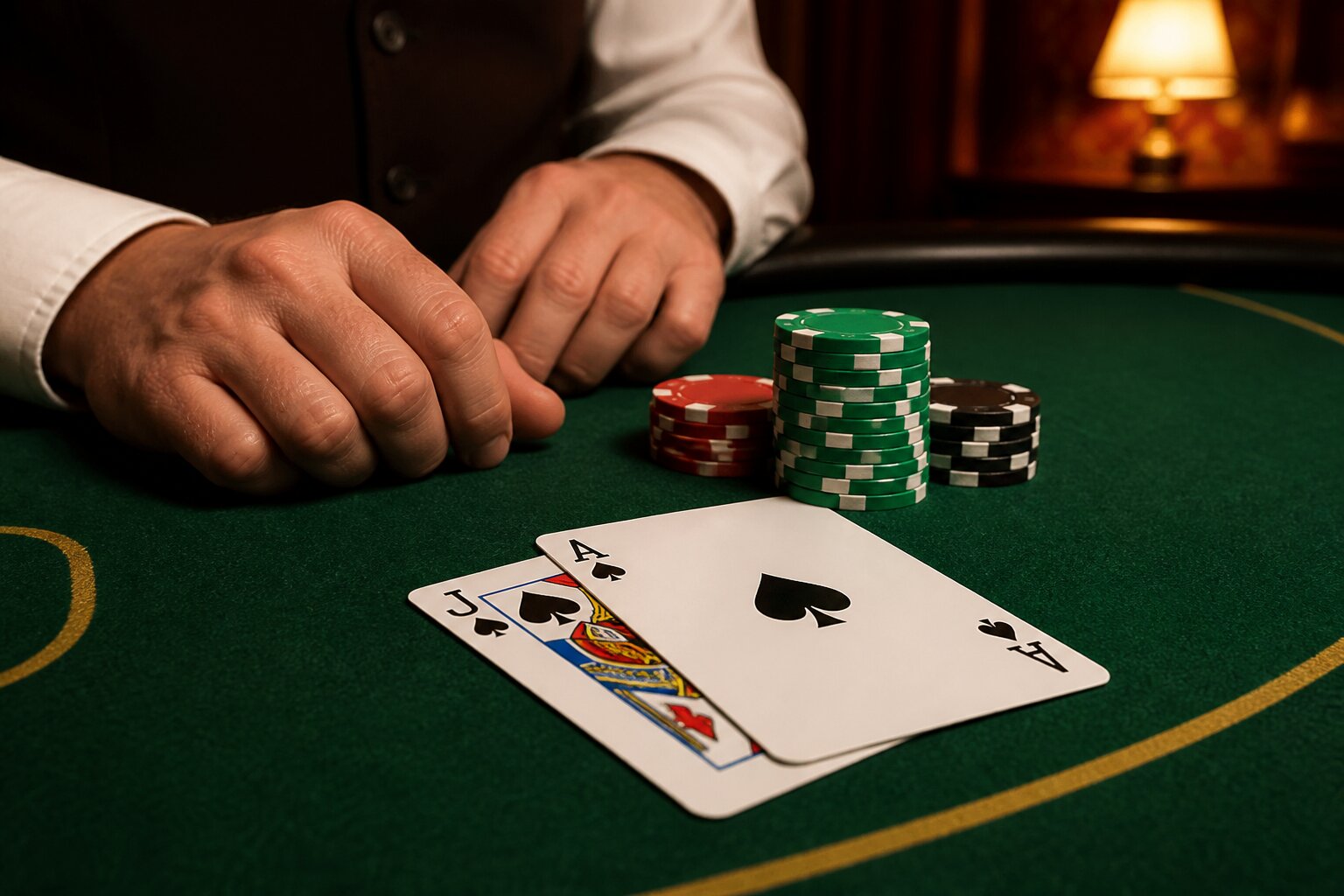
Insurance is a side wager offered when the dealer’s upcard is an Ace; it protects against the dealer having a blackjack but typically carries an unfavourable payout and different risk profile to the main bet. Bust describes going over 21, which ends the hand immediately and results in a loss. Push happens when the dealer and player finish level: the original stake is returned. A blackjack — an Ace paired with a ten-value card on the first two cards — is generally the strongest outcome and often pays better than a standard win.
With those basics in place, it’s easier to understand how rule tweaks change decisions at the table. One of the most commonly asked-about rules is DAS, explained next.
What Does DAS Mean in Blackjack?
DAS stands for Double After Split. It’s a table rule allowing a player who has split a pair to double the bet on one or both of the newly created hands. For example, splitting a pair of 8s creates two hands; on a table that permits DAS, a player who then receives a 3 on one of those split hands could double their wager on that hand and take exactly one extra card.
Whether DAS is available matters because it alters the mathematical balance of risk and reward for certain choices. Some casinos permit it, others do not, and online games usually list the rule in the game information. Knowing if DAS applies helps shape decisions about splitting and doubling, particularly when the dealer shows certain upcards. After this, the next section looks at the more casual slang you’ll hear in play and how those expressions map to the official actions.
Common Slang & Phrases at the Blackjack Table
Table talk often uses informal words that map to the official actions already described. Twist and stick are alternate ways to say hit and stand. Snapper refers to a natural blackjack — that initial Ace and ten-value combo — used as a bit of shorthand among players and dealers. Calling a card worth ten a “face” is another familiar shortcut, and the dealer’s face-up card is commonly called the upcard.
Hard hand and soft hand are terms that describe whether an Ace is being counted as one or eleven. A soft hand includes an Ace counted as eleven, which provides flexibility because the Ace can later be treated as one if additional cards would otherwise cause a bust. A hard hand either lacks an Ace or has an Ace already counting as one. A stiff hand, usually a total between 12 and 16, is one where hitting carries a significant risk of busting yet standing might leave you with a weak total against the dealer.
These conversational terms make gameplay quicker and more social, but they refer back to the concrete choices and rules you’ve already met, and they help when listening to experienced players. Next, we’ll look at how terminology and small rule differences can vary between the UK and the US.
How Do Blackjack Terms Differ Between UK and US Casinos?
Players in different countries often adopt slightly different words and customs, which can affect how natural the experience feels when visiting a new venue. In the UK you might hear 21 used as an alternative name for blackjack, and twist and stick are sometimes preferred over hit and stand. In some places the dealer might be called the banker. In the US, hit and stand are standard, and the overall table environment can include different supervisory roles and more universal use of terms like soft and hard hand.
These variations don’t change the game's mechanics, but being comfortable with local jargon makes following instructions and joining table conversation easier. When moving between regions or trying a new online game, take a moment to check the house rules so you understand any specific options or terminology in use. With that context set, the following section clears up a few common myths about blackjack language.
Key Differences in Terminology
Terminology shifts are mainly about habit rather than rules. Whether a venue calls an action by one word or another, the underlying decision — taking a card or not, splitting, or doubling — stays the same. Spotting these small differences helps avoid misunderstandings when sitting down at a table abroad or switching platforms online.
Impact on Gameplay Experience
Comfort with the language makes it simpler to focus on decisions rather than translation. Knowing local terms and any rule variations can reduce stress and keep play smoother, which is useful whether you’re playing casually or more seriously.
Myths About Blackjack Vocabulary Debunked
There are a few persistent misunderstandings about table language. One is the idea that certain words or phrases influence the outcome of a hand; in practice, terminology is purely communicative and does not change how cards are dealt or paid. Another common belief is that there is a single “correct” vocabulary; in truth, terms vary by region, venue and player group, and dealers are trained to recognise the standard range of requests.
Some players worry they must memorise every bit of slang to fit in. That isn’t necessary — understanding the official rules and a handful of common terms is sufficient to follow play and make informed choices. Clearing up these myths helps keep attention on the practical elements that matter: the rules, allowed options, and the table’s particular conditions. With misconceptions dispelled, the next part explores less-common terms you might encounter in formal or professional play.
Blackjack tables sometimes feature words and phrases that aren’t heard in most casual games. While these terms are rare, they can occur among seasoned players, in tournament settings, or as part of specific house procedures. Understanding them adds depth to your knowledge and makes it easier to read table situations when they arise.
Shoe Game
A shoe game uses several combined decks of cards placed into a device called a shoe, from which cards are dealt. Casinos favour shoes because they speed up play and reduce handling errors; shoes are common in higher-stakes games and in many automatic dealing setups online. The number of decks in the shoe affects probabilities and the dealer’s procedures, so knowing that a game uses a shoe gives a good hint about game speed and rule tendencies at the table.
Burn Card
A burn card is removed from the top of the deck and set aside unseen by players before play begins. This practice reduces the potential for marked-card advantages and adds a small layer of randomness to the starting order. In shoe games, dealing staff might burn a card after shuffling to help ensure the first few cards dealt are not predictable from any shuffling pattern.
Colour Up
Colouring up describes exchanging smaller-denomination chips for larger ones, typically when a player wants fewer stacks for easier handling or when cashing out a winning position. Dealers or cashiers perform this exchange using the chip colours designated by the casino, and it’s a routine part of table etiquette as sessions wind down.
Even Money
Even money is an option offered when a player has a blackjack and the dealer’s upcard is an Ace. Accepting even money means the player takes a guaranteed 1:1 payout immediately instead of waiting to see whether the dealer also has blackjack. It effectively removes the push possibility in that situation and can appeal to players who prefer the certainty of a smaller, immediate payout.
Penetration
Penetration refers to the proportion of the shoe that is dealt before the cards are reshuffled. Higher penetration means more of the deck has been exposed during play; for some players this affects betting strategies or card-tracking practices, while for others it simply changes when a shuffle pause will occur. Casinos set penetration for operational and security reasons, balancing game integrity with play continuity.
Anchor
The anchor is the last seat to act before the dealer plays their own hand, often called the “anchor position.” This seat can carry strategic significance because decisions earlier at the table influence how the anchor and, later, the dealer must respond. In some games the anchor has a role in table leadership or in settling disputes, but primarily it’s a positional label that affects turn order.
Hand Signal
Hand signals are simple gestures used to communicate decisions clearly, especially where cards are dealt face down or where a casino’s rules require visible intent. For example, a flat hand placed over cards indicates standing, while a beckoning motion requests another card. Signals help the dealer process actions quickly and provide a visible record of a player’s choice, which supports fairness and security in busy games.
These less-common terms are not essential for a casual game but they surface in professional or tournament environments and in many casino procedures. Knowing them gives a fuller picture of how formal play is organised and what certain table behaviours mean.
This guide has explained the core terms, a useful rule variation, regional language differences, common slang and a set of specialist expressions you might encounter. With these definitions and context in mind, you can follow table talk with greater ease, recognise which rules affect your decisions, and feel more confident when you join a game. If you’re checking table rules or trying a new game, refer to the game’s information page so you know which options — like DAS or insurance — are available before you play.
**The information provided in this blog is intended for educational purposes and should not be construed as betting advice or a guarantee of success. Always gamble responsibly.