
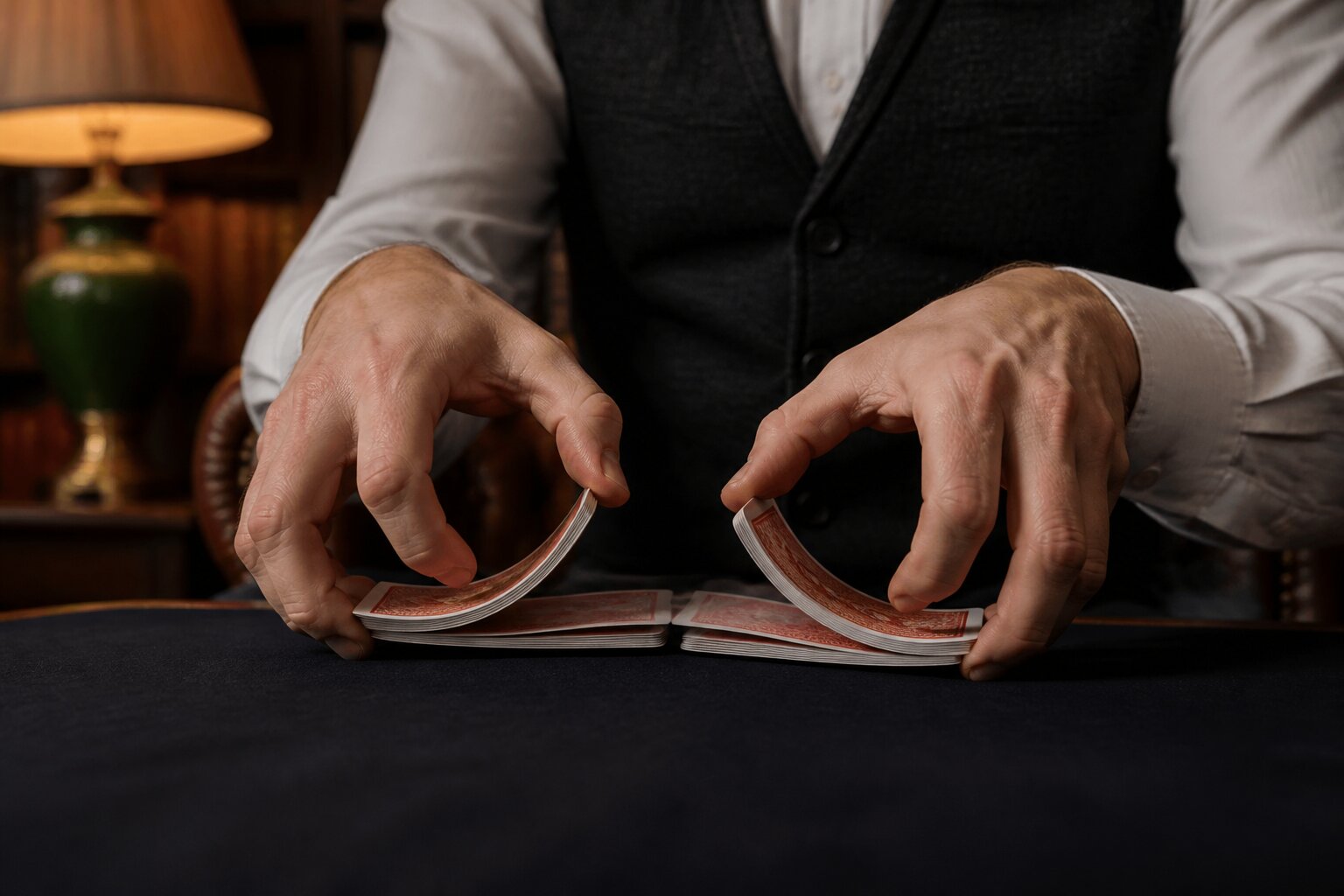
Ever wanted to impress your friends at poker night with more than just your card skills? A slick shuffle can lift the atmosphere and make a simple game feel special.
You do not need to be a magician or dealer to shuffle well. With a little focused practice you can learn techniques that look great and genuinely mix the deck.
Ready to raise your game? Dive in and discover clear tips and tricks to make your card handling smoother and more impressive.
What Makes a Good Card Shuffle?
A good shuffle achieves two things: it mixes the deck evenly and it does so without damaging the cards. Mixing evenly means reducing clumps and patterns so that no particular section of the deck remains stacked together.
Technically, a thorough shuffle randomises the order of cards so players cannot predict or influence outcomes. Practically, that translates into shuffles that interleave cards, break stacks, and redistribute suits and values across the deck.
Integrity matters. Shuffling should be used to create a fair deal for everyone, not to influence results. Keep your focus on clean handling, consistent movements, and a fair approach to the game.
Essential Equipment for Card Shuffling
You do not need specialised tools to shuffle well, but the right cards and a suitable surface make learning much easier.
A sturdy deck that holds its shape and slides smoothly will respond better to different techniques. Very old, warped, or sticky cards are harder to control and will wear faster.
A soft mat or a clean, non-slip surface protects cards and helps with grips and table shuffles. When you are not using your decks, store them flat in their box and keep them clean to extend their life.
Practise in appropriate, age-appropriate settings with people who want to play. That keeps things enjoyable and avoids problems from misuse.
How Do You Hold Cards for Different Shuffle Techniques?
How you hold the deck defines control and comfort. A relaxed grip reduces bending and slipping, while a tense hold makes even simple shuffles awkward.
For general handling, support the deck with fingers along one long edge and the thumb along the opposite edge. This gives a steady platform for most shuffles. If you have small hands, lean more on fingertip control. Larger hands can use a bit more palm support.
Different techniques ask for slight adjustments. For example, riffle-style shuffles require holding the halves by their short edges so your thumbs can release the cards in sequence. Once you understand the basic hand positions, adapting to each shuffle becomes much easier.
Classic Card Shuffle Methods Explained
These well known shuffles form the foundation of good card handling. Each one has its own feel and purpose, and together they offer a reliable toolkit for casual games and practice.
Overhand Shuffle: Step-by-Step
Before you begin, make sure you are holding the deck comfortably. The overhand shuffle uses repeated small packets taken from the top of the deck.
- Hold the deck in your non-dominant hand with fingers supporting one side and the thumb on the other.
- With your dominant hand, lift small packets from the top and let them fall into your palm.
- Continue pulling sections from the top and placing them underneath until the entire deck has passed through.
- Repeat until you are satisfied with the mix.
This shuffle is simple to learn and good for quick mixing, especially when you want to maintain control over the deck.
Riffle Shuffle: Step-by-Step
Take a moment to split the deck evenly; the riffle shuffle depends on a balanced start. The aim is to interleave cards from two halves.
- Divide the deck into two roughly equal halves.
- Hold each half by the short edges with thumbs on top and fingers below.
- Bring the short edges close together and use your thumbs to release the cards so they interleave.
- Gently push the halves together to square the deck.
When performed smoothly, the riffle gives a solid mix and has a crisp, satisfying look and feel.
Hindu Shuffle: Step-by-Step
Set up by holding the deck lengthways. The Hindu shuffle transfers small packets from the top into your other hand.
- Grip the deck lengthways in your dominant hand.
- Use the thumb and fingers of your other hand to pull small packets from the top.
- Let each packet fall into your palm and repeat until the deck is transferred.
- Continue until you feel the deck is well mixed.
This method is quick and gentle on cards, making it a practical choice for casual play.
Advanced Shuffling Techniques for Impressing Others
Once you are comfortable with the classics, advanced moves add flair and personal challenge. These are often more about display than necessity, but they do sharpen overall dexterity.
One-handed shuffles, for example, rely on coordinated finger movements and a deck that is not too stiff. They take time to learn but are rewarding to master. Table shuffles such as the Casino Wash spread the cards widely and let gravity help with mixing. These methods are commonly used by professionals for thorough mixing and for their polished appearance.
Practice advanced techniques over a soft surface to protect the cards. Aim to build smoothness and control rather than speed, and treat these moves as demonstrations of skill rather than ways to alter play.
One-Handed Shuffles: Can Anyone Master Them?
Many people can learn one-handed shuffles with steady practice. The key is to start slowly, breaking the motion into small parts—finger placement, controlled release, and a finishing push to square the deck.
A softer deck is easier to manipulate at first. Practise small reps and gradually string them together until the motion feels fluid. Over time you will find the balance between tension and flexibility that suits your hands.
Table Shuffles: Are They Necessary?
Table shuffles add variety and can produce a thorough mix when combined with other techniques. They are not essential for casual games, but they are useful when you want to ensure a thorough redistribution of cards.
A simple table shuffle spreads cards and then gathers them back, which helps break larger clumps. More complex versions are visually appealing and can be part of a sequence that demonstrates control and care.
Are Card Shuffling Tricks Bad for Your Cards?
Shuffling more often will cause normal wear, but sensible handling keeps cards usable for longer. Small, repeated stresses add up over time, so even well-made packs will eventually show signs of use.
Certain actions speed up deterioration:
- Bending or folding cards.
- Rubbing them on dirty or abrasive surfaces.
- Applying aggressive tension, such as forcing difficult cuts.
Protect cards by taking a few straightforward precautions:
- Keep hands clean and dry before handling; avoid lotions and sticky residues.
- Use soft surfaces for practice, such as a clean cloth or mat, rather than hard tabletops.
- Keep food and drink well away from your cards to prevent stains and sticky edges.
Rotate between decks if you practise a lot so no single pack becomes overly worn. Store cards upright in their box, away from direct sunlight and excessive humidity, to help preserve the finish and prevent warping. Replace a deck when edges fray, cards become noticeably slick or sticky, or the finish wears off, since damaged cards are harder to handle and can hinder progress.
Taking care of your equipment preserves performance, reduces frustration while learning, and makes practice sessions more enjoyable.
Common Mistakes to Avoid When Practising Shuffling
Beginners often tighten their grip or rush the motion, both of which make shuffles awkward and increase the chance of damage. Holding the deck too tightly causes unwanted bends. Moving too quickly before learning the motion leads to dropped cards and ingrained errors.
Using improper surfaces can also cause slips and scrapes. Practise over a soft, clean area and take regular short breaks to prevent strain. Watch for repetitive patterns in your practice that might form habits, and correct them early by slowing down and focusing on control.
Noticing these mistakes early shortens the learning curve and keeps practice productive.
Tips for Perfecting Your Shuffling Skills
Small, consistent practice sessions build muscle memory more reliably than occasional long sessions. Aim for steady repetition and focus on smoothness rather than speed. Short daily sessions of five to ten minutes are often more effective than rare, hour-long practices.
Recording yourself or using a mirror helps identify awkward wrist or finger movements. Watching playback lets you spot small tensions or uneven motions that are easy to miss in the moment. Varying techniques keeps practice interesting and develops a wider range of handling skills, so try alternate grips, angles and tempos rather than sticking to just one routine.
If your hands become tired, pause and stretch. Taking brief breaks prevents strain and helps maintain precision when you return to practice. Comfortable hands are more precise hands, so pay attention to posture and finger placement as well as to rest.
Celebrate small improvements and mix technical practice with playful exploration to keep motivation high. Set simple, measurable goals and reward progress, and occasionally experiment with new flourishes to keep sessions enjoyable.
With time and care, your shuffles will look more confident and feel more natural. Patience and regular, mindful practice are the keys to steady improvement.
Frequently Asked Questions About Card Shuffling
This section answers common concerns and clarifies what to expect as you learn.
How long does it take to learn new shuffling techniques?
Basic techniques can be picked up in a few days of regular practice. More complex moves may take weeks or months to feel natural. Progress depends on how often you practise and how you focus on technique.
Can shuffling damage my cards?
Yes, especially with heavy or forceful handling. Gentle practice, clean hands, and a soft surface reduce wear. Rotating decks also helps distribute use.
Is it okay to use the same deck for shuffling practice and games?
You can, but using one deck for practice and a cleaner deck for games helps keep your main set in better shape. A backup practice deck is a reasonable approach for frequent learners.
Does learning shuffling tricks make games less fair?
Proper shuffling techniques are intended to mix the deck and preserve fairness. When shuffles are performed openly and consistently, they help maintain an even playing field.
What is the easiest shuffle for beginners?
The overhand shuffle is straightforward and easy to control, making it a good starting point for most people.
**The information provided in this blog is intended for educational purposes and should not be construed as betting advice or a guarantee of success. Always gamble responsibly.