
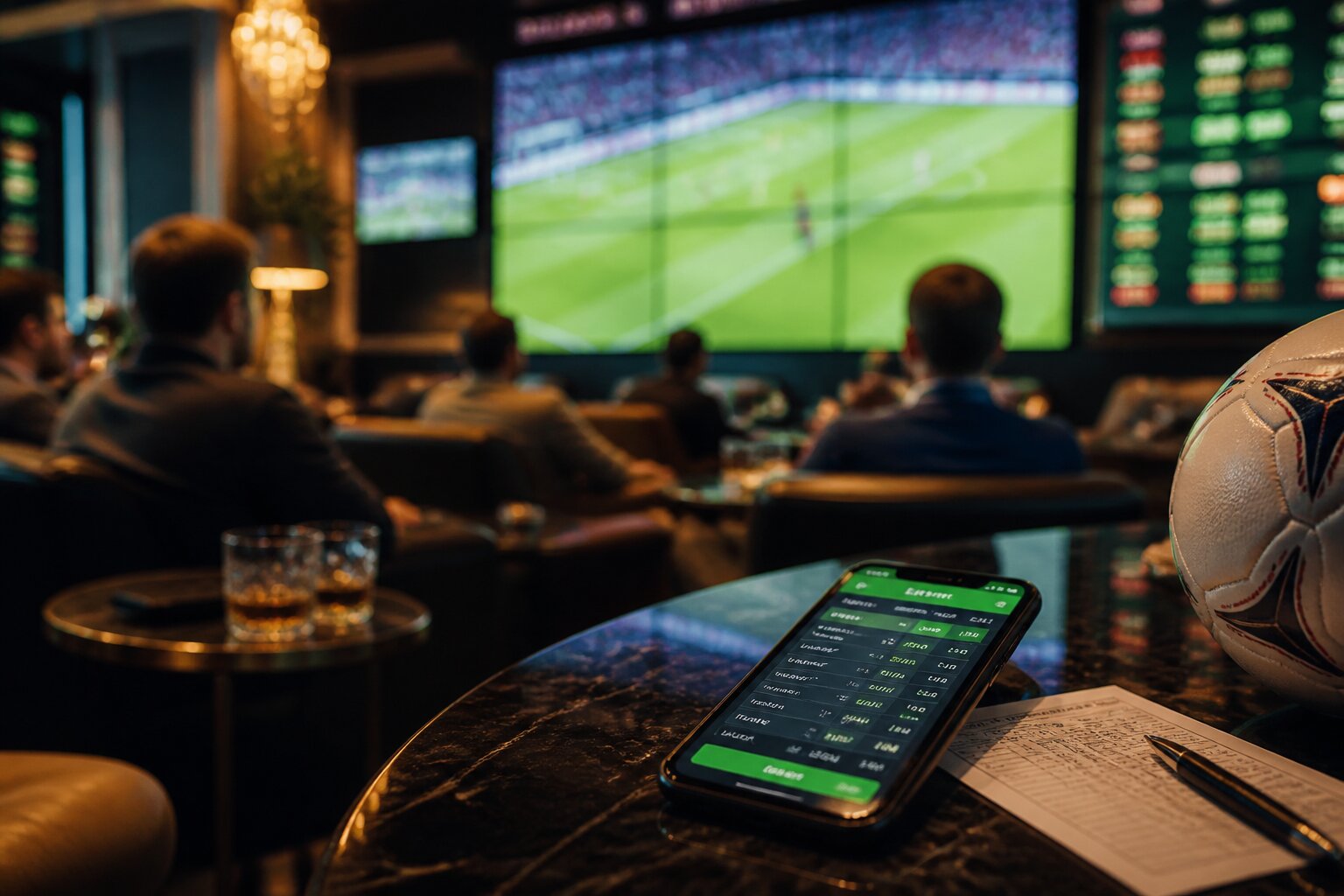
Ever wondered why, even after a few big wins, bookmakers still end up ahead? Whether you’re watching a Saturday Premier League match or checking prices on your phone, it’s tempting to think that accurate predictions will give you a consistent edge.
There’s more behind the scenes than picking winners. Bookmakers use probability, pricing strategies and a built-in margin called the house edge to make sure the business remains profitable across millions of bets.
Understanding how these elements work can change how you approach betting and help you make more informed choices. Next, we’ll define the house edge and show how it appears in everyday markets.
What Is the House Edge in Sports Betting?
The house edge in sports betting is the margin bookmakers include in their prices so they expect to profit over time. Sporting outcomes are uncertain and not controlled by operators, so the edge is created by offering odds that imply total probabilities adding up to more than 100%.
When market prices imply probabilities above 100% the excess is the bookmaker’s margin. For example, a match might be priced so the implied probabilities total 105%, which gives the operator a roughly 5% cushion against payouts. That margin is present whether you back single selections or combine multiple legs in an accumulator; the more selections you add, the more the cumulative margin works against the punter.
The house edge doesn’t stop individual winning bets — people still win sometimes — but it does mean that across a large number of bets placed by many customers, the bookmaker’s margin produces a predictable income. With that in mind, let’s look at how bookmakers arrive at the probabilities they then adjust to include their margin.
How Do Bookmakers Set Odds?
Bookmakers start by estimating the true probability of each outcome in an event, using data, form, injuries, market movements and other inputs. They convert those probabilities into decimal odds; a 50% probability becomes odds of 2.0, a 30% chance becomes 3.33, and so on.
To secure a margin, the bookmaker then shortens those odds slightly. So a selection that would be 2.0 might be offered at 1.91, reducing the payout on winning bets. Those small reductions across all outcomes are where the house edge is introduced.
Odds are also influenced by how much money is being staked on each side. A bookmaker will adjust prices to balance liability — encouraging bets on one outcome and discouraging them on another — which reduces risk and helps lock in the built-in margin. These pricing and balancing decisions lead naturally into the technical concept of overround, which quantifies that margin for an entire market.
Understanding Overround and Its Impact
Overround is the sum of implied probabilities from every outcome in a market; when that sum exceeds 100% it shows the bookmaker’s margin. Converting odds to probabilities reveals the overround and makes clear how the operator’s advantage is calculated.
For instance, if three horses are priced such that their implied probabilities add to 110%, the extra 10% is the overround. That excess reduces the theoretical payout a punter would receive if all outcomes were backed, giving the bookmaker a buffer against variance and ensuring a positive expected return across many bets.
Overround varies by market. Major football matches and highly traded markets typically have lower overrounds because competition keeps prices tight, whereas more obscure events or complex markets can carry larger margins. Understanding overround helps explain why long-shot accumulators and niche markets often pay less well relative to the true chances involved. With the mechanics of overround clarified, it’s useful to compare how this approach to margin relates to casino products and player results.
Casino Profits vs Player Winnings
Both casinos and bookmakers rely on a built-in advantage to make long-term profits, but the mechanics differ by product. In slots and table games the house edge is usually expressed as return-to-player (RTP). An RTP of 96% means that, over a very large number of spins, the game will pay out around £96 for every £100 wagered, leaving £4 to the operator as the edge.
In sports betting the overround serves a similar role: it reduces the expected payout across outcomes so the bookmaker retains a portion of stakes as profit. For customers, results are less predictable — some will enjoy a string of wins, others will lose — but the operator’s margin smooths returns at scale.
Another difference is how volume and volatility affect outcomes. Casinos manage near-continuous play and tightly controlled game rules, so their revenue streams are highly predictable. Bookmakers face unpredictable sporting events, but can offset that by balancing stakes, using liability limits and applying margins across many markets so their overall position remains profitable. These contrasts help clarify common misconceptions about the possibility of consistently beating the bookmaker’s margin.
Common Misconceptions About Sports Betting Edges
There are several persistent myths about beating bookmakers. Two of the most common relate to systems and expertise. These misconceptions often stem from anecdotes, selective recall of wins, and an underestimation of how bookies balance risk across many markets.
Is It Possible for Players to Beat the House?
No betting system can guarantee long-term profit against a market that includes a persistent margin. Short runs of favourable results can and do occur, but they do not change the market structure that reduces expected returns to the punter over time. Over many bets the built-in margin tends to assert itself, meaning that systems based on patterns or staking plans cannot overcome that structural disadvantage.
Luck and variance can make systems seem effective in the short term, but this is not the same as a reliable, repeatable profit model. Players who experience temporary success with a system often find it fades as sample size grows or as bookmakers adjust their prices and limits.
Does Skill Negate the House Edge?
Research and expertise can help identify mispriced bets and occasionally produce an edge on a specific market or selection. However, expertise does not erase the overround across a bookmaker’s range of markets. Bookmakers also monitor accounts and markets closely; when genuine pricing errors occur they are rapidly corrected, which limits the opportunities for sustained advantage.
Skilled punters may achieve short-term wins by exploiting inefficiencies, superior modelling, or faster access to information. Even so, those gains are usually constrained by market corrections, reduced limits, or account restrictions, so skill improves outcomes but does not guarantee long-term dominance over the operator.
These points emphasise that while skillful evaluation can improve the quality of decisions, it does not remove the core economic mechanism that gives the operator its edge. Next we’ll look at how regulation frames those market practices and protects customers.
Regulation and Fairness: Protecting Bettors
The UK’s regulatory framework requires operators to run markets transparently and treat customers fairly. Rules govern how odds are displayed, how bets are settled and how operators manage customer accounts and funds.
Regulators insist on clear terms, prompt payment of winnings and robust checks to prevent underage play or criminal activity. Operators must also offer tools such as deposit limits and account controls so customers can manage their activity. Providing access to support organisations and self-exclusion tools is a regulatory expectation rather than repeated messaging within this article.
These safeguards create a more reliable environment for customers and set standards for how margins and market conduct are monitored. With that regulatory context in mind, the final section pulls the main ideas together and explains what they mean for someone placing bets.
The Bottom Line: How the House Stays Ahead
Bookmakers stay profitable through probability-based pricing, overround and careful risk management. By converting estimated outcome chances into odds and then shortening those prices slightly, operators embed a margin that produces a predictable return across many bets. Market adjustments and liability balancing further protect the bookmaker’s position.
While individual punters can achieve notable wins, the structural advantage lies with the operator over a large sample of bets. Regulation ensures markets are run transparently and that customers have access to protections and support if needed.
**The information provided in this blog is intended for educational purposes and should not be construed as betting advice or a guarantee of success. Always gamble responsibly.