
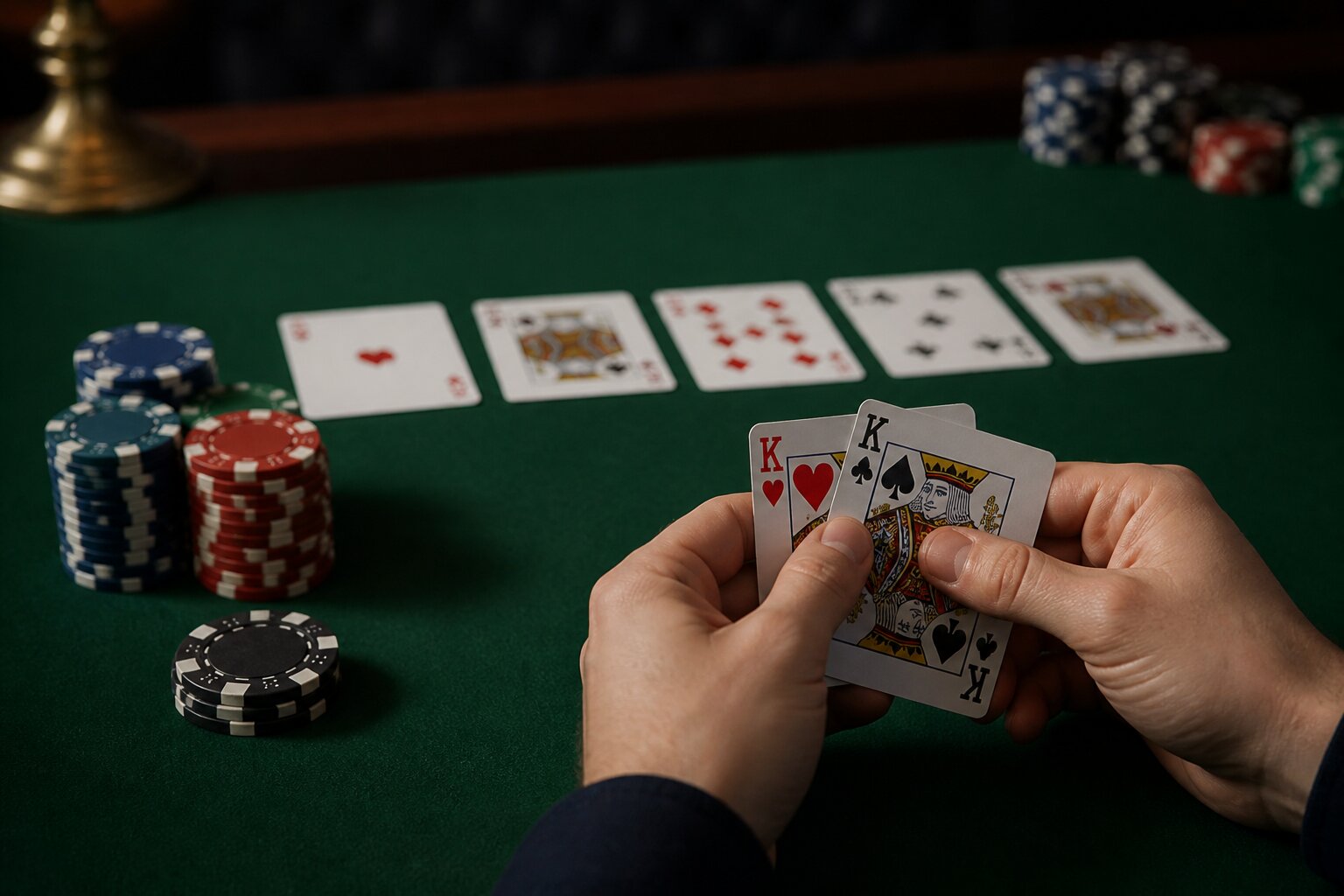
Ever found yourself deep into a tense poker hand, trying to work out how likely it is that your opponent holds the one hand that beats you? You’re not alone. The sharpest players rely on more than intuition — they use “combos” as a practical tool to decode the situation at the table.
Combos, or combinations, are calculations that tell you how many distinct ways someone can hold a particular hand given the cards you can see. Think of it as counting the different two-card starting hands that still exist, so your decisions are based on concrete possibilities rather than guesswork. But what exactly are these combos, and how can they be used to make better choices at the table?
What Is a Combo in Poker?
In poker, a “combo” means one specific pairing of two hole cards a player could have, given the deck. It’s a straightforward way to count how many different versions of a starting hand exist.
Take Ace-King as an example. For suited Ace-King there are four combos: spades, hearts, diamonds and clubs. For offsuit Ace-King there are twelve combos, because there are 16 total Ace–King pairings minus the four suited cases. Pocket pairs, like two Queens, work differently: with four Queens in the deck you can make six distinct pocket-pair combos.
This method of counting lets you see exactly how many possible hands are in play, which makes it easier to form realistic assessments as a hand develops. Next, we’ll look at how those counts are worked out in practice.
How Are Poker Combos Calculated?
Calculating combos is a matter of simple card counting based on the cards that remain available.
Suited hands: each suit provides one unique suited combo, so any suited two-card hand has four combos. Offsuit hands: start with the 16 total pairings of the two ranks (4×4) then subtract the four suited pairings to get twelve offsuit combos. Pocket pairs: choose two cards from the four available of the same rank, which gives six combinations using the combination formula 4 choose 2.
When cards are already visible on the board or held by known players, those available combos reduce accordingly. For instance, if one Ace is on the board, the number of Ace-King combos involving that Ace disappears from the unseen combinations, and your counts should be adjusted.
Knowing how to recalculate combos as the board changes helps keep your assessments accurate and prepares you to use that information strategically, which is what the next section explores.
Why Do Poker Combos Matter?
Combos matter because they provide a clear, numerical sense of how many hands in an opponent’s possible range actually exist. That clarity helps you judge whether a bet from your opponent is more likely to be strength or a bluff, and it refines your choices in marginal spots.
For example, if only a few combos beat your hand but many more combos represent weaker holdings, that balance can justify a call. Conversely, if many combos beat you and only a few represent bluffs, a fold is often the better decision. Combos also feed into hand-selection decisions pre-flop, helping you evaluate whether a particular situation is worth contesting based on the likely composition of opponents’ ranges.
Used alongside reads on tendencies and observed betting patterns, combos form a reliable foundation for decision-making under uncertainty. With that foundation in mind, the following section shows how combos are applied in specific strategic contexts.
Where Are Combos Used in Poker Strategy?
Combos shape several practical parts of strategy by turning abstract ranges into countable sets of hands. They are used when building ranges, deciding on bluffing frequency, and choosing value-betting targets, among other tasks. Thinking in combos helps players make more precise decisions rather than relying on vague impressions or gut feelings alone.
Using Combos for Hand Ranging
When estimating an opponent’s range, counting combos narrows the field to what’s realistic. Imagine the board has three hearts and an opponent shoves. Counting how many suited combinations remain that complete a flush tells you whether that shove is likely to be a made flush or something weaker.
If there are only a couple of top-flush combos but many more medium-strength heart hands or non-flush holdings, that balance informs whether calling is sensible. Combining this numerical view with reads on betting patterns and stack sizes makes your assessment more robust and less prone to error.
Bluffing and Value Betting Decisions
Combos also guide the selection of which missed draws or weak made hands to use as bluffs, helping to maintain a credible bluff-to-value ratio. If your range contains many missed-draw combos but only a few strong-value combos, choosing a smaller subset of missed-draw combos to bluff preserves balance and reduces predictability.
That careful choice both protects the stack and keeps opponents guessing, rather than making repeated, easily read bluffs. Over time, consistently applying combo-based thinking makes your overall strategy harder to exploit and more adaptable to different table dynamics.
These applications show how combo counting turns abstract concepts into concrete choices, and the next section explains how suits influence those counts.
How Do Suits Affect Poker Combos?
Suits limit or expand possible combinations, so suit distribution is essential to accurate counting. For a given two-card starting hand, suited cases always have fewer combos than offsuit ones because the two cards must share the same suit.
For example, Queen-Jack suited has four distinct combos — one for each suit. Queen-Jack offsuit has twelve combos, because most pairings of Queen and Jack are of different suits. When suits appear on the board, the number of suited combos remaining for players shrinks, which makes some holdings inherently less likely and others relatively more so.
Understanding these suit-based constraints refines your range estimates as the hand develops. With suits accounted for, it’s useful to be aware of common misunderstandings that can lead players astray.
Common Misconceptions About Poker Combos
One common mistake is assuming every two-card hand always yields sixteen combos; that only applies to unconstrained offsuit pairings and breaks down for suited hands, pocket pairs and once cards are known. For pocket pairs, there are six combos, not sixteen. When cards are visible or blocked by action, available combos must be reduced.
Another error is letting combo counts dominate every decision. While combos give a numerical backbone, they work best when combined with reads on opponents, betting patterns and position. Actions taken earlier in a hand change the likelihood of particular combos — for instance, a passive line by an opponent can make very strong pre-flop hands less probable.
Finally, some players assume all combos within a range are equally likely. In practice, betting behaviour and game flow make some combos more credible than others, and weighting those differences leads to better play.
A clear, balanced use of combos—alongside behavioural reads and game context—improves decision-making without promising guaranteed results. Keep this measured approach in mind as you apply combo counting at the tables, and remember to manage play within safe limits.
Enjoy Casino Games at Barbados Bingo
Fancy exploring a world of entertainment with us? We’d be thrilled to welcome you to Barbados Bingo, where you can enjoy your time playing a variety of casino games.
Joining us is simple: just create your account, make a deposit and you’ll be ready to get playing. We look forward to seeing you around and sharing plenty of enjoyable moments together.
**The information provided in this blog is intended for educational purposes and should not be construed as betting advice or a guarantee of success. Always gamble responsibly.