
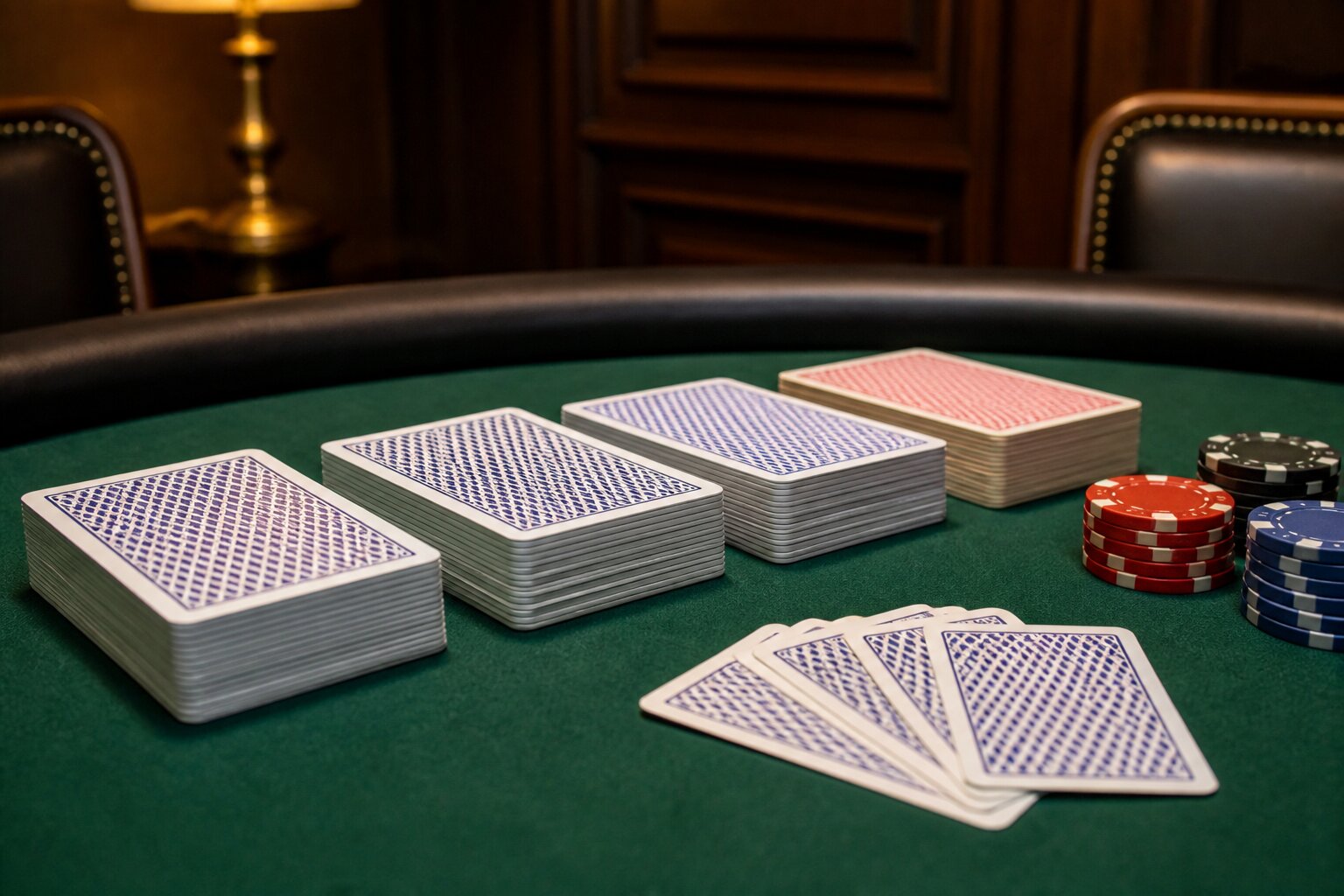
Whether you’re new to poker or have watched a few games, the pace and variety can spark questions about the basics — like how many decks are used. Different settings and variants bring small rule differences, and understanding the deck setup helps you follow the action and feel confident at the table.
This article explains the standard deck practices across popular poker versions, why multiple decks sometimes appear, and how to check what you’re playing with. Read on to get clear, practical answers and a few helpful pointers for when you sit down to play.
How Many Decks Are Standard in Poker Games?
In most formal poker play — tournaments, casinos and reputable online tables — a single 52-card deck is used for every hand. That deck contains four suits: hearts, diamonds, clubs and spades, with no jokers included. Popular variants such as Texas Hold’em, Omaha and Seven Card Stud all rely on this single-deck format.
The deck is shuffled before each hand and may be examined or monitored to ensure fair dealing. That consistency keeps the game predictable in terms of rules and probabilities, and it’s why a standard deck is the baseline for serious play.
Home games sometimes adopt their own variations, but when you join a game in a regulated or organised setting you should expect a single deck unless you’re told otherwise.
Why Do Some Poker Variations Use Multiple Decks?
Multiple decks tend to appear in informal or social games rather than official play. The usual reason is practicality: with many players, having a second deck ready to deal can reduce downtime between hands and keep the table moving.
Other informal variations add extra decks or jokers simply to create a different game experience. These house rules change how hands form and which combinations are possible, so they’re chosen for novelty rather than competitive fairness.
If you’re invited to a new game, a quick question about the deck arrangement will tell you whether the rules differ from standard single-deck poker.
Popular Poker Variants & Their Deck Requirements
Here are common poker variants and how many decks they use in standard play. This gives a clear picture of what to expect at most tables.
- Texas Hold’em: single 52-card deck, no jokers.
- Omaha: single 52-card deck, no jokers.
- Seven Card Stud: single 52-card deck, no jokers.
- Five Card Draw: single 52-card deck regardless of table size.
- Dealer’s Choice: typically single deck, though informal home games might use a spare deck for faster dealing.
These setups are about game conduct rather than advantage. Knowing the usual format helps you join smoothly and understand the odds and strategy involved.
Are Jokers Included in Poker Decks?
Jokers are not part of the standard poker deck used in formal play. Most organised games use only the 52 standard cards so that hand rankings and probabilities remain consistent and fair across players.
In casual settings you may encounter jokers being used as wild cards, which can substitute for other cards to form stronger hands. These house-rule variants can significantly change strategy and the relative value of hands, so they should be clearly explained before play begins.
When wild cards are in use, make sure players know:
- whether one or both jokers are included,
- what a joker can substitute for and any restrictions,
- how jokers affect hand rankings and payouts.
If you are unsure when joining a game, asking the dealer or host about jokers and wild-card rules is a quick way to avoid surprises and disagreements. Some games and electronic machines also include jokers for specific variants, so always check the rules for the particular game you are playing.
Does the Number of Decks Affect the Game Experience?
Using more than one deck changes the pace or feel of a session rather than the fairness of the game. Extra decks can speed things up in busy social games, and wild-card variations can make hands less predictable in terms of combinations.
For players focused on strategy, the single-deck standard offers consistent conditions that match most study materials and tournament formats. In informal games, different deck arrangements are a matter of preference and should be agreed on beforehand so everyone has the same expectations.
If the setup makes the game unfamiliar, a brief chat about the rules will usually clear things up and help you settle into the right mindset for that table.
Myths About Poker Decks: Common Misunderstandings
A few persistent myths can confuse newcomers, so it helps to separate fact from rumour. One misconception is that extra decks give certain players an edge; in properly run games everyone plays under the same conditions, so deck count is not used to favour anyone. Another is that jokers are standard — in reality they are only used in specific house variants.
Some players worry that “house rules” around decks might hide unfair practices. In regulated or reputable venues, rules are clear and open, and any deviations are typically limited to casual games where all players agree in advance.
Asking plainly about the deck and wild-card rules before play begins is the simplest way to avoid misunderstandings.
How to Check the Number of Decks in Your Poker Game
It’s wise to confirm the deck setup before joining a table so you know what to expect and can adapt your approach.
Checking online
On well‑run sites, game rules and table descriptions include deck information and any special variants. Look for a help or rules section associated with the table you’re joining.
Asking in live games
At a live table, a polite question to the dealer or host about the deck and whether jokers or wild cards are used will clear things up. Hosts are usually happy to explain before cards are dealt.
Our commitment
We make game rules and deck information easy to find so players can make informed choices. If anything is unclear, contact our support team and they’ll clarify the setup before you join a table.
Knowing the deck arrangement is a small step that helps the rest of the game fall into place — once that’s settled, you can focus on playing under consistent, transparent rules and enjoying the experience responsibly.
**The information provided in this blog is intended for educational purposes and should not be construed as betting advice or a guarantee of success. Always gamble responsibly.