
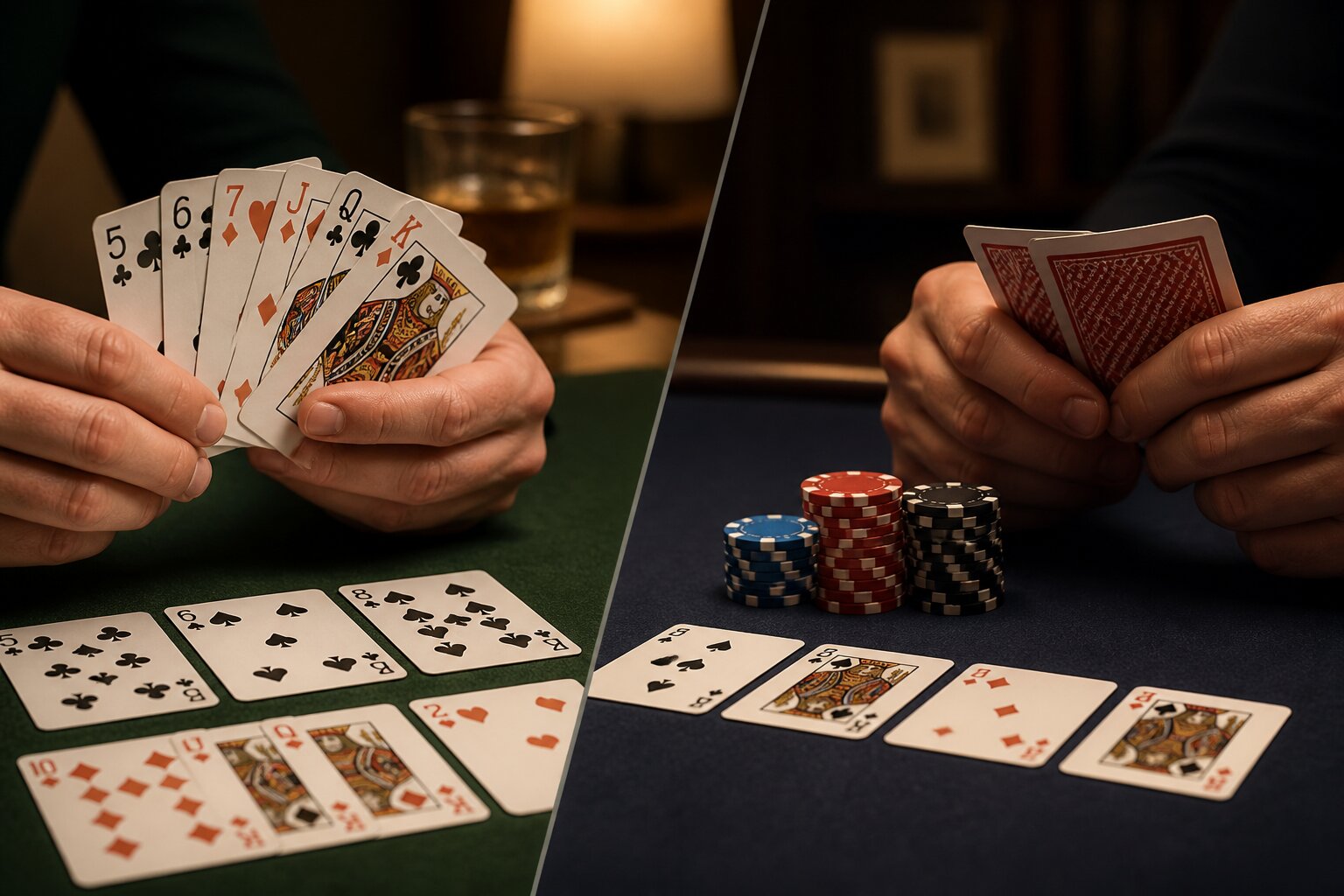
Thinking about picking up a new card game but torn between Rummy and Poker? Both are popular, well-established games with clear differences in how they’re played and the skills they reward. This article walks you through those differences, explains the rules for each, and helps you decide which might suit you best.
We’ll cover the essentials without repeating the same points, and point out what to look for if you play online. Read on to find the game that fits your style and how to get started with confidence.
What Are the Key Differences Between Rummy and Poker?
Rummy and Poker share a deck of cards, but their objectives and pacing are distinct.
Rummy focuses on forming sets and runs from your hand. Players draw and discard as they assemble groups such as three of a kind or sequences in a single suit. The rhythm is steady and largely driven by hand management and attention to which cards have been used.
Poker centres on creating the strongest five-card hand or convincing opponents to fold through betting. Many versions use community cards that everyone can combine with their private cards. The flow is punctuated by betting rounds, which brings strategic choices about risk and timing.
Skill shows up differently in each game. Rummy rewards memory, pattern recognition and efficient card management. Poker places greater emphasis on betting strategy, hand-reading and psychological play. Both require fair conduct and an understanding of rules and etiquette.
If you plan to play for real money, choose reputable sites and be clear about your limits. That helps keep the experience controlled and enjoyable.
How Are Rummy and Poker Played?
The two games use similar physical components but run very different rounds.
Rummy rounds are driven by drawing and discarding. Players replenish their hands and attempt to convert loose cards into valid sets or runs. Play continues until a player declares a complete hand, at which point others score the cards they have left.
Poker rounds revolve around dealing and betting. Depending on the variant, players receive private cards and sometimes share community cards. Players then place bets in sequence, and after a final betting round the best hand wins the pot or the remaining players concede before showdown.
Both games can be adapted for casual or more competitive play. They also vary by regional rules and the particular version you choose, so it helps to agree house rules before starting.
Card Values and Decks Used
Rummy commonly uses one or two 52-card decks and may include jokers as wild cards. Card points tend to match face value: numbered cards score their number, face cards are worth ten and aces can be one or eleven depending on the variant.
Poker uses a single 52-card deck without jokers in most popular forms. Suits are equal in value and rank matters for hand strength. An ace can be high or low within certain hands.
How to Win in Each Game
In Rummy, a player wins by organising their entire hand into valid sets or runs and declaring it before opponents do. Scoring varies by version, but the central aim remains the same: complete your combinations while minimising leftover cards.
In Poker, a player wins by holding the best five-card hand at showdown or by betting in a way that causes all other players to fold. Success depends on the cards, the betting structure and strategic reads on opponents.
What Are the Basic Rules of Rummy?
Rummy is easy to pick up once you know the essentials. Players are dealt a set number of cards, commonly 13 in many versions. The remaining pack forms a draw pile and one card is turned up to start the discard pile.
On a turn, a player takes one card from either the draw pile or the discard pile and then discards one card back to the discard pile, keeping their hand size constant. The aim is to create combinations: sets of the same rank or runs of consecutive ranks in a single suit.
Many versions require at least one pure run with no wild cards before you can declare. When a player believes their hand meets the rules, they reveal their cards for validation. Scores are then calculated based on remaining cards in opponents’ hands or by tallying points over several rounds.
What Are the Basic Rules of Poker?
Poker has many variants, but the underlying structure is familiar: players receive cards, place bets over several rounds and compare hands at the end if more than one player remains.
In community-card versions like Texas Hold’em, players combine private cards with shared community cards to make the best five-card hand. In stud games, players receive a mix of face-up and face-down cards. Betting options include checking, calling, raising or folding, and betting continues until players have either matched the highest bet or folded.
After the final betting round, remaining players reveal their hands at showdown and the highest-ranking hand wins the pot. Betting strategies, position at the table and how players interpret opponents’ actions all matter to the outcome.
Can You Play Rummy and Poker Online in the UK?
Online Poker is widely available through regulated operators in the UK. These platforms run a variety of formats, from cash games to tournaments, and provide features such as play-money tables and different stakes.
Online Rummy for real money is less common in the UK market, though social or free-play versions exist. Whether you choose Poker or Rummy online, check that the operator is regulated and that games are clearly described in terms of rules and stakes.
Before staking money, review deposit and withdrawal methods, how disputes are handled and any protections offered by the operator. Clear terms and transparent game rules make for a better experience.
Which Card Game Is Right for You?
Choosing between Rummy and Poker depends on what you enjoy in a game.
If you prefer methodical play that rewards pattern recognition and hand organisation, Rummy provides a satisfying, measured challenge. It suits players who like steady decision-making, careful planning and the quiet satisfaction of arranging sets and runs over several hands.
If you enjoy dynamic interaction, strategic risk-taking and layers of social play, Poker offers more variety through betting and bluffing dynamics. Poker rewards reading opponents, adapting to changing table conditions and making high-impact decisions under pressure.
Trying both in a low-stakes or free-play setting is a good way to see which matches your temperament. Playing casually lets you explore the rules and feel of each game without financial pressure.
Consider which of the following you value most, and pick the game that aligns with those preferences:
- Speed: whether you prefer fast rounds or longer, more deliberate play
- Social interaction: how much you enjoy table talk, bluffing and reading others
- Strategic depth: whether you favour long-term planning and pattern recognition or adaptive, risk-based tactics
Play responsibly and within your means, and choose the game that gives you the most fun and satisfaction.
Common Myths About Rummy and Poker
Several misunderstandings persist about these games.
One is that winning comes down only to the cards you receive. While the deal matters, both games reward skillful decisions, careful observation of opponents and timely adaptation to changing circumstances. Players who practise reading table dynamics and refining their timing generally perform better over many sessions than those who rely solely on luck.
Another myth is that there are foolproof systems that guarantee wins. Well-crafted strategies can improve your long-term performance by reducing mistakes and improving decision-making, but no approach eliminates risk entirely. Always allow for variance, set realistic goals and manage your play so that short-term losses do not lead to risky behaviour.
Concerns about fairness are often raised too. Reputable platforms and competitive settings use clear rules and independent oversight to ensure games are conducted properly. Before you play, it is sensible to verify the operator’s credentials, such as:
- whether they hold a recognised licence from a reputable regulator
- if their random number generator or shuffle process is independently audited
- what measures are in place for dispute resolution and player protection
Taking these simple checks helps protect your experience and promotes safer, fairer play.
Conclusion: Choosing Between Rummy and Poker
Both Rummy and Poker have clear merits and different appeals. Rummy centres on card organisation and steady, tactical play. Poker adds layers of betting and player interaction that reward psychological insight and risk management. Try both in friendly games or free online tables to see which feels right.
When you play with money, do so with care. Use trusted, regulated platforms, set sensible limits and treat gaming as entertainment. If you ever feel play is becoming a problem, support and advice are available. Enjoy the cards and make choices that keep the experience positive.
**The information provided in this blog is intended for educational purposes and should not be construed as betting advice or a guarantee of success. Always gamble responsibly.