
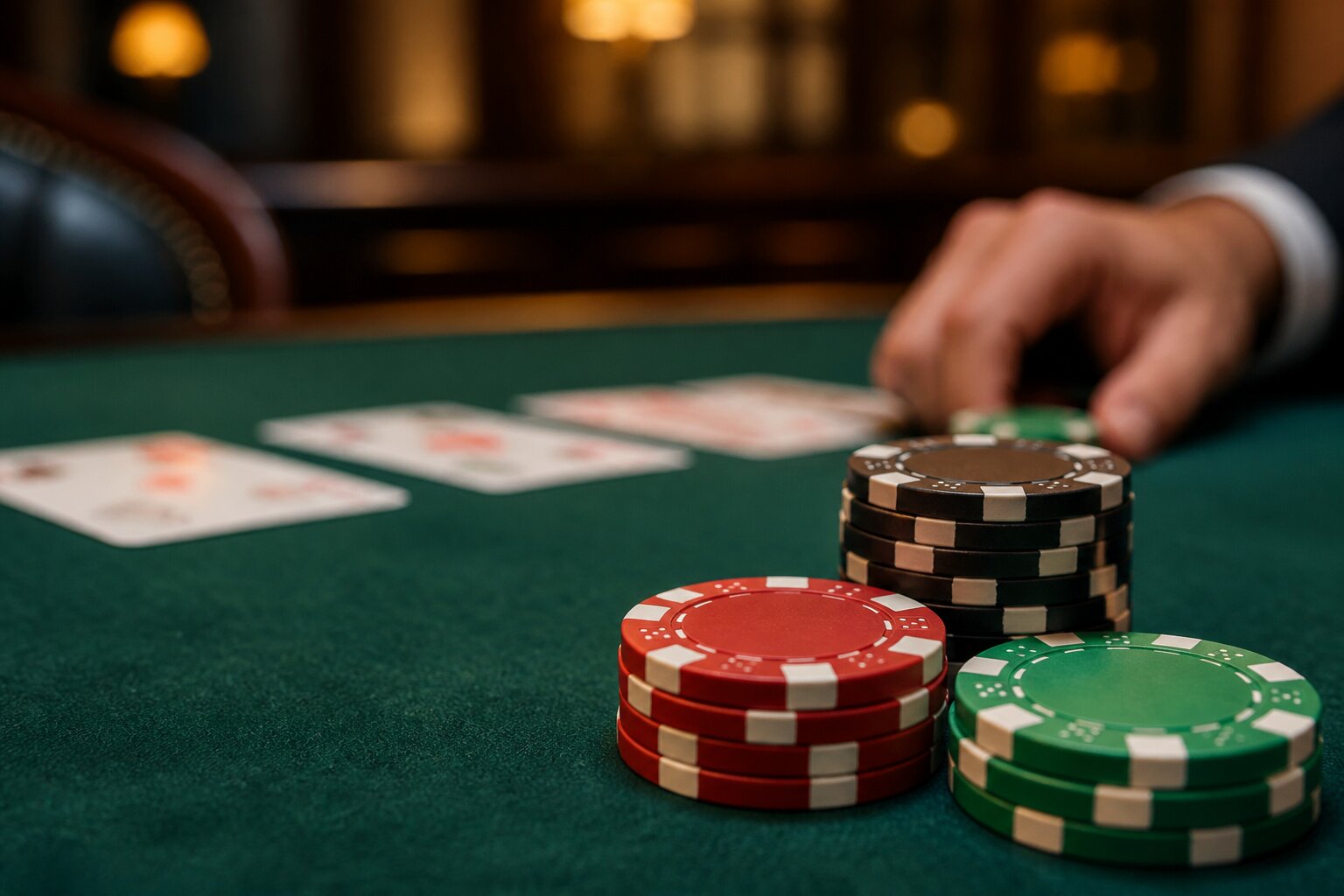
Blackjack throws up a handful of tense choices, and the option known as “even money” is one that trips up many players. It appears at a very particular moment—when you have a blackjack and the dealer shows an Ace—and asks you to decide before the dealer’s hole card is revealed.
This article explains what even money actually does, why it’s offered, and the practical maths behind taking or declining it. Read on to understand the pros and cons so you can make a confident call at the table.
What Does Even Money Mean in Blackjack?
Even money is an offer that appears only when you have a two-card blackjack and the dealer’s visible card is an Ace. Instead of waiting to see whether the dealer also has blackjack, you can accept a guaranteed 1:1 payout on your stake immediately.
To illustrate: a £10 bet with a blackjack normally pays £25 back if the dealer does not also have blackjack (that is, £15 profit plus your £10 stake). If you accept even money, you receive £20 total right away (your £10 stake plus £10 winnings). If you decline and the dealer does have blackjack, the hand is a push and you simply get your original stake back.
This option short-circuits the normal outcome and replaces the higher potential payout with a lower guaranteed one. That trade-off is the core of the decision, and it leads naturally into how and when the offer is presented at the table.
How and When Is the Even Money Offer Made?
The even money offer arises only after the initial deal, when you hold a two-card blackjack and the dealer’s upcard is an Ace. At that point, the dealer will ask if you want even money before checking the hole card. The offer is only for players who have blackjack; other hands are not eligible.
The timing matters because the dealer makes the offer before revealing whether they have blackjack. Players must answer immediately; the round then continues depending on the choice. Understanding this sequence helps clarify the practical effect of even money, which is why it’s useful to look next at the casino’s reasons for offering it.
Why Do Casinos Offer Even Money?
Even money exists as a rule-driven option within standard blackjack play. When a player has blackjack and the dealer’s upcard is an Ace, the offer lets the hand be settled immediately. For the casino, this streamlines play and creates an extra decision point for the player without changing the underlying rules of the game.
From a player perspective, the offer is simply an alternative to waiting for the dealer’s result. It doesn’t alter the probabilities in the shoe; it converts a potential 3:2 payout into a guaranteed 1:1 payment for that hand. With that in mind, the next question is whether converting that potential into certainty is beneficial, and the answer comes down to both strategy and mathematics.
Is Taking Even Money Ever a Good Idea?
Whether to accept even money depends on what a player values in that moment: immediate certainty or the higher expected return of the normal payout. Some players prefer the guaranteed 1:1 because it eliminates the possibility of a push; others prefer to play for the 3:2 payout and accept the small risk of tying.
Personal comfort with risk, session goals, and bankroll approach influence the choice. Over many hands, the higher payout tends to be more profitable, but single sessions and individual preferences can justify either approach. With that context, it helps to compare even money with the related option of insurance so the distinctions are clear.
Comparing Even Money and Insurance Bets
Both even money and insurance appear when the dealer’s upcard is an Ace, but they are not identical in how they operate. Insurance is available to any player who wants to hedge against the dealer holding a ten-value hole card; it is a separate side bet, typically half the original wager, that pays 2:1 if the dealer has blackjack.
Even money, by contrast, is offered only to players who already hold blackjack. Mathematically, accepting even money is equivalent to taking insurance on your blackjack and settling that insurance immediately, so their outcomes line up in practice. A common misconception is to treat them as entirely different options, but once the maths is considered their relationship becomes clearer.
Understanding how both options function clears the way to examine the actual probabilities that should influence a decision.
Mathematics Behind the Even Money Bet
The maths centres on the probability the dealer’s hole card is a ten-value card. In a fresh single deck there are 16 ten-value cards out of 52, so roughly four out of 13 upcards would complete a dealer blackjack. In typical multi-deck games used in casinos the proportion is similar, and so the basic probabilities remain close to that ratio.
Since the standard blackjack payout is 3:2, refusing even money usually yields a higher expected return over time than accepting the 1:1 payment. Accepting even money reduces the long-term payout rate and therefore slightly increases the house advantage relative to playing out the hand. This is why many players and analysts prefer to decline even money in the long run.
The probabilities can shift a little depending on the deck composition later in a shoe, which is why experienced players sometimes vary their choice based on the flow of the cards rather than treating the decision as fixed. With the numerical picture in place, it’s useful to see what seasoned players typically recommend.
What Do Experienced Players Recommend?
Experienced players and analysts tend to favour declining even money because the expected value of waiting for the full 3:2 payout is higher. This preference is grounded in the probabilities described above rather than intuition, and players who focus on maximising return usually choose to play the hand out.
That said, many experienced players also emphasise context: session objectives, comfort with variance, and how a single hand fits within a broader bankroll plan. Some will accept even money occasionally for psychological reasons or to lock in a modest win in a tight session. Those differing approaches reflect that blackjack decisions combine numerical thinking with personal priorities.
If those personal priorities are important to you, the next section offers a concise way to bring them together when making a choice at the table.
Should You Take Even Money or Decline It?
Deciding whether to accept even money is a balance between immediate certainty and higher expected returns. If the priority is to secure a guaranteed smaller payout and remove the uncertainty of a push, taking even money can make sense. If the priority is maximising expected value over many hands, declining is generally the better option.
Players who prefer a firm plan often set this preference before play begins, which simplifies the decision in the moment. Others treat it as situational, influenced by deck readings or session goals. Either approach is reasonable provided it fits personal limits and expectations.
Keep that balance in mind as you decide at the table—the choice is yours and should align with how you want to play and manage your bankroll. The closing section summarises the most useful points to take away.
Final Thoughts on Even Money in Blackjack
Even money is a clear-cut option presented in a narrow situation, and it trades a higher potential payout for an immediate, lower one. For most players aiming to maximise long-term return, declining even money will be preferable. For those who prioritise certainty or who are managing a particular session, accepting it is a valid alternative.
Make choices that match your goals and bankroll limits, and remain mindful of your own comfort with variance. Above all, play within your means and keep the experience under control so that decisions at the table reflect reasoned preference rather than impulse.
**The information provided in this blog is intended for educational purposes and should not be construed as betting advice or a guarantee of success. Always gamble responsibly.