Ever found yourself shuffling a deck of cards and wondering why 5 Card Draw remains one of the most popular home games around? There’s something satisfying about the quick-fire bluffing, the clatter of chips, and the moment everyone reveals their hands at the end of a round.
If you’ve heard phrases like "a pair of jacks" or "three of a kind" at the table but never been completely sure what they mean, this guide will walk you through the rules, the hand rankings and how a typical round unfolds. Before we begin, remember that real-money play is for adults aged 18 and over and should always be done within sensible limits.
Read on to learn how the game works and what to watch for when you’re deciding whether to hold or to try for a better hand.
What Is 5 Card Poker?
5 Card Poker is a classic form of poker where each player is dealt five private cards and, in the common draw version, has a single opportunity to exchange any number of those cards. Unlike games that use shared community cards, every decision in 5 Card Draw revolves around what you keep in your hand and what you choose to reveal at showdown.
Its origins go back to the 19th century, and the format has endured because it is straightforward to learn while still offering room for strategy and bluffing. The lack of community cards means players must judge opponents from betting patterns and the few reveals that happen over the course of play.
This simplicity makes 5 Card Draw a favourite for home games and casual tables. Up next we’ll look at how a round typically unfolds, from the ante to the final showdown, so you’ll know what to expect at the table.
How Do You Play 5 Card Draw?
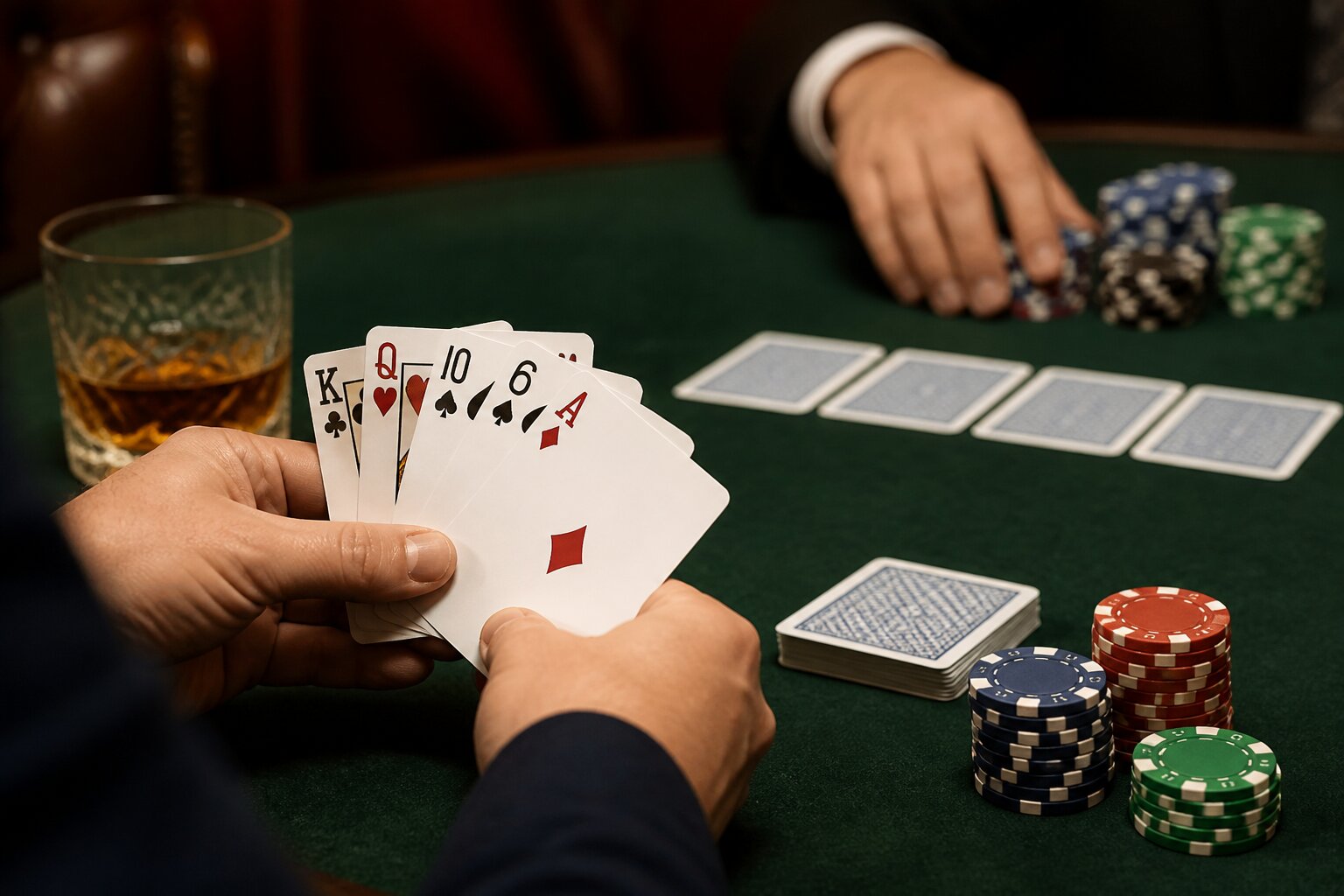
A round begins with each player placing an ante to create the starting pot. Everyone is then dealt five cards face down and keeps these private. Play proceeds with a first round of betting, where players may call, raise or fold depending on their assessment of their hand.
After that betting round comes the draw phase. Players may discard and replace any number of their cards from the deck, including holding all five if they prefer. For instance, someone holding four cards of one suit might discard a single off-suit card in the hope of making a flush, while a player with a single pair might exchange three cards to try for a better combination.
When the draw ends, a final round of betting takes place. If more than one player remains after that, the hands are revealed at the showdown and the highest-ranking hand wins the pot. That sequence of ante, bet, draw, bet and reveal keeps the game brisk while giving players a clear chance to improve their position.
Next, the rules that govern these stages are covered in more detail, including common betting actions and typical table sizes.
5 Card Poker Rules Explained
5 Card Poker is normally played with two to six players and a standard 52-card deck. The dealer position rotates so that every player gets to act in different seats over successive hands. Betting structures vary, with common options being limit, pot-limit or no-limit stakes, so it is important to agree the format before play begins.
Play moves clockwise and during betting rounds players may:
- Check, when no bet has been made and you choose to pass the action while remaining in the hand.
- Call, to match the current highest bet and stay in.
- Raise, to increase the size of the bet and put pressure on others.
- Fold, to withdraw from the round and forfeit any claim to the pot.
The classic draw format permits a single draw, though some house rules allow extra exchanges. After the draw and final betting, any remaining players show their hands and the best five-card combination wins. Keeping a clear understanding of the betting options and the agreed draw rules helps avoid disputes and keeps the game flowing.
Now that the structure is clear, the next section explains exactly which hands beat which, with examples to make the rankings easy to remember.
Hand Rankings in 5 Card Poker
Winning in 5 Card Poker depends on forming a higher-ranking five-card hand than your opponents. The hands below are listed from highest to lowest, with examples to illustrate each one.
Royal Flush: Ten, jack, queen, king and ace all in the same suit.
Example: A♠ K♠ Q♠ J♠ 10♠
Straight Flush: Five sequential cards all of the same suit, not specifically ten to ace.
Example: 8♥ 7♥ 6♥ 5♥ 4♥
Four of a Kind: Four cards of the same rank plus any other card.
Example: 9♣ 9♥ 9♠ 9♦ 2♠
Full House: Three cards of one rank and two of another.
Example: K♣ K♠ K♦ 3♣ 3♥
Flush: Five cards of the same suit that are not in sequence.
Example: Q♣ 10♣ 8♣ 6♣ 2♣
Straight: Five cards in sequence in mixed suits.
Example: 10♦ 9♠ 8♣ 7♥ 6♦
Three of a Kind: Three cards of the same rank plus two unrelated cards.
Example: 5♠ 5♥ 5♣ Q♦ 3♣
Two Pair: Two different pairs plus a fifth card.
Example: J♠ J♣ 4♥ 4♠ 9♦
One Pair: Two cards of the same rank plus three unrelated cards.
Example: 8♦ 8♠ Q♥ 6♣ 4♠
High Card: When none of the above applies, the highest single card determines the winner.
Example: A♣ J♦ 9♥ 7♠ 2♣
Most hands you encounter in casual play will be pairs or high-card showings, so stronger combinations are relatively rare and often decisive. Understanding these rankings helps with both the draw decision and post-draw betting choices. The following answers address common practical questions players have about the game.
Common Questions About 5 Card Draw
5 Card Draw is approachable yet offers room for advanced play, which prompts a few frequent questions from newcomers and experienced players alike. Its straightforward structure makes it an excellent starting point for learning poker fundamentals, while the deeper strategic elements keep it engaging for regular players.
Can You Play 5 Card Draw Online?
Yes. Many online poker platforms offer 5 Card Draw alongside other variants, with options for both play-money tables and real-money games for eligible players. These sites often provide practice tables to learn the pace and flow without financial risk. Features such as hand histories, tutorials and adjustable betting limits can also help players improve at their own speed.
How Many Players Can Join a Game?
Tables generally hold two to six players. Smaller games tend to be faster and slightly more tactical, as each decision carries more weight when fewer opponents remain. Larger tables can create bigger pots and more varied betting dynamics, which can reward different strategies and increase the social aspect of the game.
What Happens After the Draw?
Once players have exchanged cards, a final betting round occurs. Players may check, call, raise or fold in sequence. Any remaining players then reveal their hands at the showdown, and the best five-card hand wins the pot, after which play resets for the next deal. Ties are settled according to standard hand ranking rules, and any split pots are shared between the qualifying players.
With the fundamentals covered, it helps to compare how 5 Card Draw differs from other popular poker variants to understand when it suits a particular setting or group. Whether played casually at home, in club environments or on regulated online sites, 5 Card Draw remains a flexible and enjoyable choice for many players.
The Difference Between 5 Card Draw and Other Poker Variants
5 Card Draw differs from community-card games in one major way: each player’s best hand comes entirely from the cards they hold. There are no shared cards on the table, so the whole contest centers on personal hand construction and interpreting betting behaviour.
In Hold’em, players receive two private cards and combine them with five community cards to form the best five-card hand. That shared information makes gameplay more open and often produces more complex multi-street strategies. Omaha expands on the community-card idea by dealing four private cards and requiring players to use exactly two of them along with three community cards, which increases the possible hand combinations.
Because 5 Card Draw’s action focuses on one draw and private hands, it tends to be quicker and easier to pick up, making it ideal for home games and casual sessions. The privacy of each player’s cards produces a different kind of psychological play compared with community-card formats, where more information is visible at each stage.
Whether you prefer the mystery of private hands or the layered tactics of community-card games, 5 Card Draw offers a clear, compact test of reading opponents and choosing when to improve your hand. If you want to try it, use the rules here as your guide and enjoy the game within sensible limits.
Play Casino Games at Barbados Bingo
We welcome you to be part of our friendly community, where players come together to enjoy the experience and excitement of casino games. Discover new ways to play and share the fun with us.
Getting started is easy: just create an account, make a deposit and you can begin playing. We look forward to seeing you at Barbados Bingo.
**The information provided in this blog is intended for educational purposes and should not be construed as betting advice or a guarantee of success. Always gamble responsibly.