Ever sat at a blackjack table and heard someone say, “You can just tell if you’ve got a winning hand from the very first cards”? Maybe you’ve wondered if certain starting cards mean you’re bound to win or lose, or if there’s an opening hand that’ll always beat the dealer. It’s easy to pick up ideas like these amid the chatter and excitement of twenty-one.
Many smart-sounding pieces of advice get passed around about what those first cards supposedly mean, yet not all of them stand up to how the game actually works. Some popular beliefs about the initial deal can steer decisions the wrong way if they’re taken as fact.
Understanding what really happens when the first cards are dealt — rather than relying on myths — helps you play with more confidence and enjoy the game more. Read on to see which stories hold up and which are best left at the table.
What Are Blackjack Starting Cards?
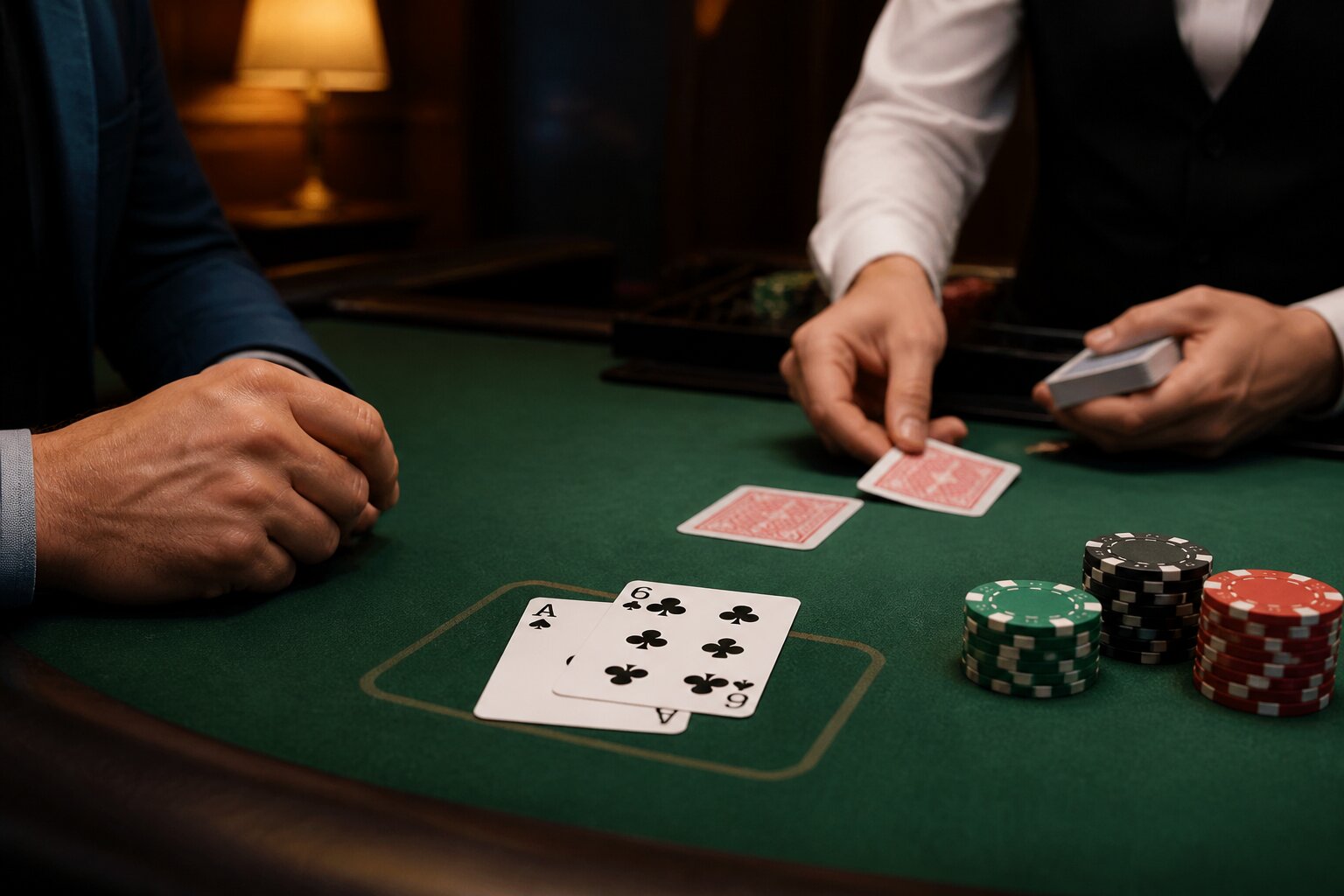
Blackjack starting cards are simply the first two cards dealt to a player at the start of a round. These two cards determine the immediate choices available: to hit, stand, split, or double down. For the player, both cards are usually visible, while the dealer shows one card and keeps the other concealed.
Some starting hands have special names and implications. An Ace paired with a ten-value card is a "blackjack", the strongest opening hand and one that typically pays out immediately unless the dealer also has the same. A pair of tens is a high total but not invincible.
Beyond just the player’s cards, the dealer’s visible card also informs strategy. Seeing a dealer upcard that is weak or strong influences the risk you should take with your own starting hand. That interplay between your two cards and the dealer’s upcard makes the opening moments of a round strategically important, and it’s this relationship that gives rise to many myths about the initial deal. This leads naturally into the most common of those beliefs about opening hands.
Popular Misconceptions About the First Two Cards
Many players think some opening hands decide the round before any further play, but that’s a misunderstanding. A pair of tens is a solid total, but it doesn’t guarantee a win; further cards still change the outcome. Conversely, a low starting total such as 4+5 is not hopeless — with sensible decisions it can still turn into a winning hand.
Another frequent claim is that a dealer showing an Ace means a certain loss for the player. An Ace is certainly a strong upcard, but it does not determine the result on its own. Outcomes depend on the cards that follow and on how the player and dealer play their hands.
These myths often persist because memorable wins and losses stick in the mind, creating a distorted sense of cause and effect. The opening cards influence strategy, but they don’t lock in a result. That distinction helps explain why fairness and randomness in dealing are so important to understand next.
Is the Initial Deal Really Random?
Fair dealing is a core part of regulated play. In physical games, dealers or automatic shufflers mix the cards to remove predictable sequences. In digital versions, outcomes are produced by certified random-number systems that mimic the unpredictability of shuffled cards.
These measures are checked and tested by independent assessors to confirm the dealing is unbiased. As a result, neither the table nor the operator can steer which two cards land in anyone’s hand. Each deal is independent: past rounds do not influence the next, and the order of unseen cards cannot be inferred from the opening deal.
Knowing that initial deals are random should change how the first cards are regarded: they are data for decision-making, not signs of something inevitable. That clarification helps when considering whether the dealer has an innate advantage from the outset.
Myths About Dealer and Player Advantage
Many believe the dealer has a built-in advantage immediately from the first deal, while others assume certain starting hands automatically favour the player. The true source of the house edge is not any single opening card but the rules about play order and payouts.
Does the Dealer Always Have a Better Chance?
The dealer acts after the player, following fixed rules for hitting or standing. Because a player who busts loses before the dealer plays, this order creates a modest house edge. It’s not the initial two cards themselves that give the advantage; it’s the structure of play that matters.
A dealer’s visible card may appear strong, yet that shows only part of the picture. Only after both sides have completed drawing does a final result emerge, so early impressions can be misleading rather than decisive.
Do Certain Starting Hands Favour the Player?
Certain openings do change the statistical balance. A true blackjack is the clearest example of a starting hand that improves player outcomes because it usually pays extra and resolves the round immediately unless matched. Most other hands, however, provide only incremental differences in expectation and still rely on how the remainder of the round unfolds.
Rather than treating particular starting cards as guarantees, it’s more useful to view them as inputs to sound decision-making under the rules of play. With that perspective, attention often turns to whether tracking cards from the start can ever offer a practical edge.
Common Beliefs Around Card Counting and the Initial Deal
Card counting is a long-discussed topic in blackjack. The basic idea is to note whether cards shown so far are mostly high or low to estimate the composition of the undealt cards. Some suggest that seeing the first two cards might reveal patterns or hints about what follows, but in modern play that information is extremely limited.
Players often overestimate the value of the opening cards because they are salient and memorable. A strong or weak first hand can feel like a sign of the shoe to come, but this impression is driven more by psychology than by mathematics. In regulated environments the ways decks are handled, shuffled and rotated reduce any signal those first cards might carry about future sequences.
Can You Predict the Next Cards from the First Deal?
Seeing the first two cards gives no reliable information about the order of the remaining deck or decks. When many decks are used and shuffling is frequent, the sequence of future cards is effectively unknown. Each card dealt is part of a much larger, mixed set, so the initial pair does not let a player foresee the next draws.
Even in single-deck play, the chance of inferring the next few cards from just two is negligible. The combinatorial possibilities remain vast, and without observing a meaningful sample of cards the deck composition cannot be estimated with practical accuracy. Modern dealing procedures aim to maintain randomness so that early cards do not translate into predictive power.
Is Card Counting Effective from the Start?
Counting systems require observing many cards over many hands to have any statistical relevance, and they depend on conditions that are rarely present in regulated play. For most contemporary settings, including electronic dealing where each deal is independent, the opening hand is too small a sample to change odds meaningfully.
Successful counting also needs consistent rules, limited shuffle frequency, and opportunities to vary bet sizes based on an established count. These conditions are uncommon in licensed venues, which use countermeasures and game designs that reduce the effectiveness of such strategies. Understanding these practical limits helps explain why counting is a long‑running curiosity rather than a reliable tactic for most players.
Understanding the limits of counting and the independence of deals helps explain why superstitions around the initial deal endure — which brings us to the cultural side of the game.
Why Superstitions Around the Initial Deal Persist
Superstitions thrive in environments where outcomes matter to people and where memorable events are shared. A dramatic win following a particular routine, or a losing streak that coincides with a seat or habit, can create a story that spreads among players. Those stories become rituals: tapping the table, crossing fingers, picking a seat.
These behaviours offer social rituals and a sense of control, even though they do not affect card outcomes. Treating these actions as part of the game's atmosphere is reasonable, provided play remains within personal limits. Enjoy the company and the rituals, but keep choices about stakes and time grounded in what’s affordable and sensible.
By separating the cultural aspects from the mechanics of dealing, players can enjoy the social side without mistaking ceremony for strategy. That balance leaves you better equipped to approach each new deal with clear expectations and sensible decisions that fit your aims.
Play Casino Games at Barbados Bingo
We'd love for you to become part of our friendly community of players at Barbados Bingo. Enjoy the thrill of casino gaming in a welcoming and enjoyable atmosphere on our site.
Joining us is easy: simply create an account, make a deposit and you can start playing in just a few steps. We look forward to welcoming you and hope you have a great time exploring our games.
**The information provided in this blog is intended for educational purposes and should not be construed as betting advice or a guarantee of success. Always gamble responsibly.