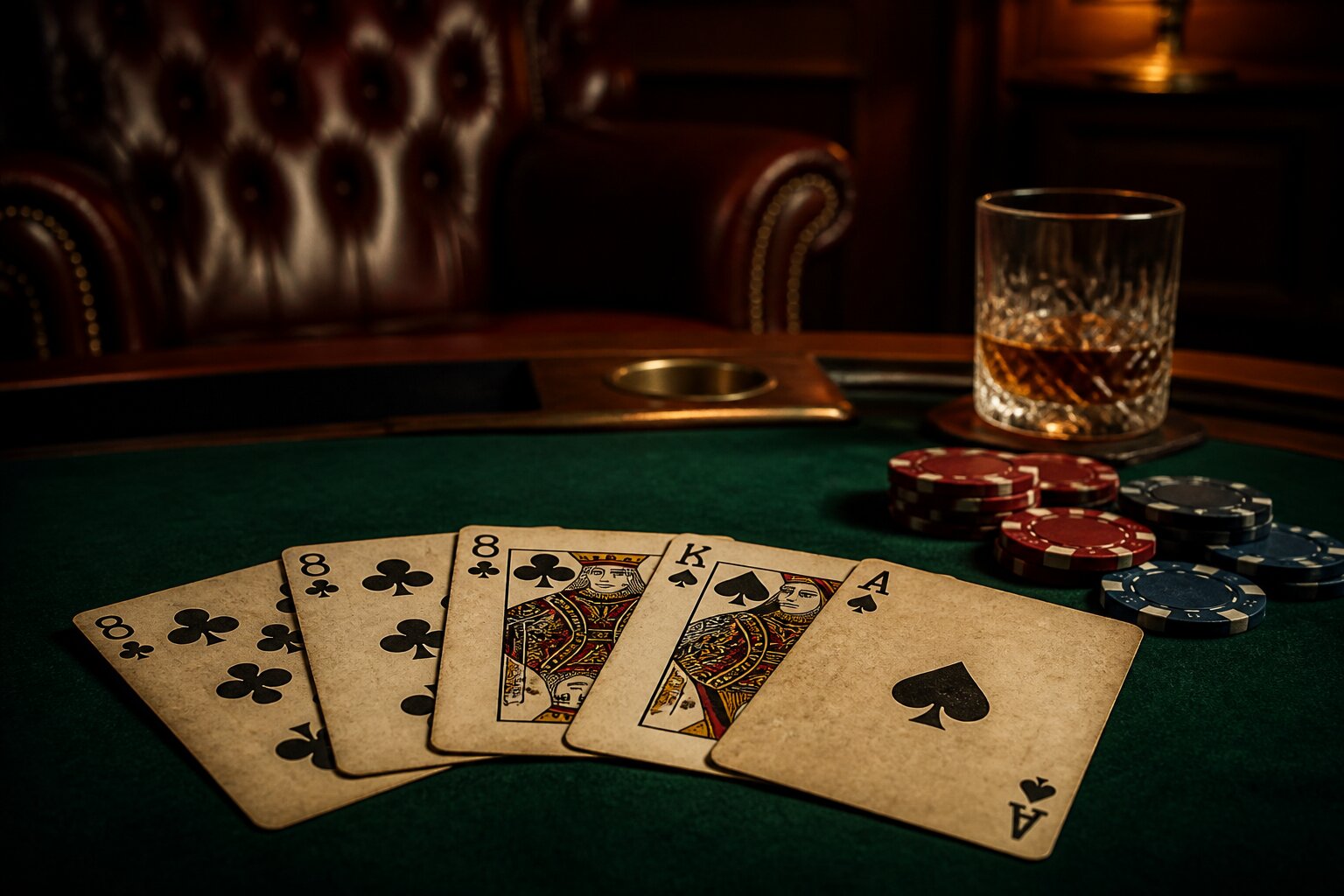
Imagine sitting at a poker table, glancing down at your hand and seeing two black aces and two black eights. For some, it’s just another combination; for others it carries a chill, tied to the most notorious moment in poker history.
The cards have been retold in stories about Old West saloons, high-stakes gamblers and a sudden, dramatic end involving one of the era’s most colourful figures. The Dead Man’s Hand has migrated from frontier folklore into film, books and pub conversation across the UK.
What follows traces the hand’s origins, the man most associated with it, how the cards became symbolic and the many ways they turn up in popular culture.
What Is the Dead Man’s Hand?
The Dead Man’s Hand is a specific poker combination: two pairs made up of the black aces and the black eights. That means the ace of spades and the ace of clubs paired with the eight of spades and the eight of clubs, with any fifth card completing the five-card hand.
On the felt it is simply a two-pair—respectable, but not unbeatable in most variants. Its distinctiveness comes from the exact pairing of the two black aces with the two black eights rather than from any special rule or advantage in play. The traditional emphasis is on those four cards; the fifth card can be any value or suit.
This clear visual identity made the combination easy to attach a story to, which leads us into the tale behind the cards.
Origins of the Dead Man’s Hand
The hand is most famously linked to James “Wild Bill” Hickok, shot dead while playing poker in Deadwood on 2 August 1876. Contemporary reports of his death do not record the exact cards, and later accounts filled the gap with the image of Hickok clutching two black aces and two black eights.
The phrase “Dead Man’s Hand” began to appear in print in the late 19th century, but early instances varied—some accounts named other card combinations. It wasn’t until the 20th century that the black aces and eights became the widely accepted definition.
Because the story grew through retelling, the line between fact and embellishment blurred. Still, the evocative image of those four cards at a violent death proved compelling enough to lodge the hand firmly in poker folklore. Next, we’ll look at the man at the centre of the story and why his life invited such myth-making.
Who Was Wild Bill Hickok?
Wild Bill Hickok—born James Butler Hickok in 1837—was a frontier figure known as a lawman, gunslinger and gambler. He built a reputation for quick-draw skills and colourful exploits that made him a subject of newspapers, dime novels and popular storytelling in his own lifetime.
What Happened at the Poker Table?
On the afternoon of 2 August 1876, in a Deadwood saloon, Hickok was shot from behind while seated at a poker table. Accounts describe him sitting with his back to the door—uncharacteristic for someone wary of ambush—when Jack McCall approached and fired a fatal shot. Later retellings claim the four black cards were in his hand as he fell, with the fifth card unspecified.
The absence of a contemporary, definitive inventory of the cards helped later commentators and storytellers to fix on the memorable image of two black aces and two black eights, which in turn hardened into the modern legend.
Legacy in American Folklore
Hickok’s dramatic end turned him into a fixture of Old West lore. His story appears in films, television and novels; historical markers in Deadwood note the site associated with his death. Artists and manufacturers have reproduced the imagery of the hand on commemorative playing cards and posters, ensuring the legend stays visible.
Those cultural traces—monuments, media and merchandise—help explain how a specific card combination moved from an anecdote into a recognisable icon. With that background in place, the next section examines why the hand acquired an eerie reputation at the gaming table.
Why Is the Dead Man’s Hand Considered Unlucky?
The Dead Man’s Hand took on an ominous reputation largely through association: the notion that Hickok held those cards when he was killed transformed the combination from coincidence into a symbol of misfortune at the table.
Poker culture often layers symbolic meaning onto hands, and this is a prime example. The image of black aces and eights became shorthand for a grim outcome or a foreshadowing of trouble, appearing in conversation and sympathy for ill-timed deals.
Players may mention the hand at social games or bring it up in tournament banter; pubs and card rooms sometimes use the phrase as a narrative device. Those uses are cultural rather than technical—the cards themselves carry no mechanical curse and play like any other two-pair combination in a hand.
Having explored the symbolism, the next section looks at the broader influence the Dead Man’s Hand has exerted across poker culture and design.
How Has the Dead Man’s Hand Influenced Poker Culture?
The hand’s story has woven itself into the visual and verbal fabric of poker. Designers and artists frequently reproduce the black aces and eights motif on posters, playing-card decks and memorabilia, and special-edition decks sometimes pay explicit tribute to the theme.
Tournaments and social events occasionally borrow the name for atmosphere or promotional flavour, and commentators might drop the phrase when an equivalent combination appears at table. Pubs, casinos and private card rooms display artwork or keepsakes that reference the hand, turning it into a recognisable emblem for players and collectors alike.
These cultural echoes reinforce the hand’s place in poker lore without affecting how the cards function in play. One persistent strand of the hand’s presence is how it appears in stories and media; the following section details some notable examples.
Depictions of the Dead Man’s Hand in Popular Media
The Dead Man’s Hand is a ready-made symbol for drama and mystery, and it turns up across television, film and literature as a visual or narrative device.
- Deadwood (TV series): the hand is referenced in relation to Wild Bill Hickok’s fate, fitting the show’s Old West setting.
- Aces & Eights (1950 film): a Western that uses the infamous cards as a symbol tied to betrayal.
- The X-Files (episode "Wild Men"): the hand appears as a clue within a poker scene, adding tension to the plot.
- The Prestige (2006 film): a brief poker-table moment uses the hand to underscore themes of secrecy and consequence.
- Dead Man’s Hand (edited by Otto Penzler): an anthology of stories and essays themed around the legend, showing its literary reach.
- Supernatural (TV series): the hand features in an episode concerned with dangerous bargains, further spreading the myth.
These examples illustrate how the image of the four black cards has become shorthand for danger, mystery or turning points in narrative storytelling. The hand’s reach into different media keeps the legend alive and ensures it remains one of poker’s most recognisable motifs.
Play Casino Games at Barbados Bingo
We welcome you to enjoy the entertainment and friendly atmosphere our site has to offer. Whether you are new to online casino games or have plenty of experience, we are here to make your visit enjoyable.
Getting started is a breeze: simply create an account and make a deposit, then you can explore our games at your own pace. We look forward to sharing the fun with you.
**The information provided in this blog is intended for educational purposes and should not be construed as betting advice or a guarantee of success. Always gamble responsibly.