
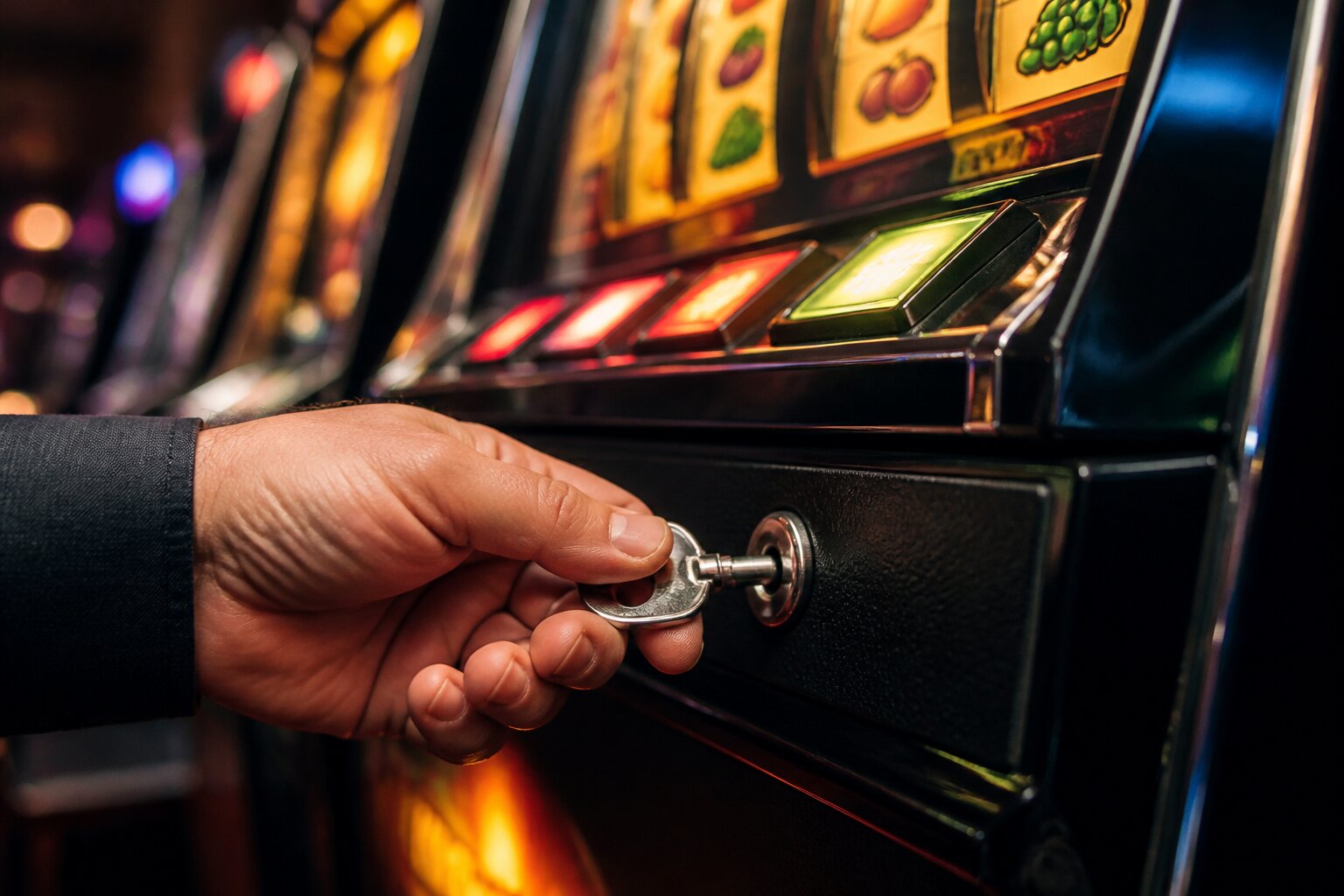
Ever wandered past a fruit machines in your local pub and spotted someone with a curious silver key, twisting it into a lock around the back or side? It’s enough to make anyone do a double take. What exactly does that key do, and why do so few people seem to have one?
Fruit machines—common fixtures in British pubs, arcades and clubs—aren’t just about spinning reels and flashing lights. Behind the displays sits a network of engineering and security designed to keep the games working and compliant. The reset key is one of those plain-looking but important tools that staff and engineers use to manage faults and maintenance.
If you’ve heard stories about keys that let people change payouts or unlock jackpots, this guide will separate fact from fiction and explain how these keys fit into the regulated system that keeps play fair and transparent. Next, we’ll define exactly what a reset key is and why it matters.
What Is a Fruit Machine Reset Key?
A fruit machine reset key is a small metal key made for authorised staff and service engineers. It generally resembles a utility or tubular key, often silver or chrome, with a shaped end that fits a particular lock on the cabinet.
Its purpose is practical: to give staff controlled access to certain machine functions. That can include clearing error codes, resetting the machine after a technical fault, or opening the cabinet for maintenance checks. In some machines, authorised personnel use the key to reach a service or configuration menu, but the options available there are limited to approved maintenance tasks.
These keys are strictly for staff use and do not provide any way for a player to influence game mechanics or change payout settings. UK regulation requires operators to control who has access, and only licensed personnel or registered technicians should hold or use them. With that context, the next section explains how those keys interact with the machine’s electronics.
How Do Slot Machine Reset Keys Work?
When a machine flags a fault—say a jammed component or an internal error—an authorised member of staff may use the reset key to begin recovery. The key is inserted into a lock on the cabinet or inside a service panel; turning it completes an electrical circuit that tells the machine’s control system an authorised action is being performed. That can clear certain error codes or open a service menu for diagnostics.
In practical terms, a typical incident unfolds like this: the machine stops due to a fault; staff open the service panel with the key; turning it starts the reset routine; the machine runs self-checks and returns to service when those checks pass. This process restores normal operation only—it does not change how the game behaves or its programmed payout parameters. Records of such interventions are kept to maintain an audit trail and show that any maintenance was conducted appropriately. With that clear, we can look at the variety of keys and systems in use.
Types of Slot Machine Keys Explained
Slot machine access methods vary by age and model, and the security choices operators make reflect that. The two main approaches are physical keys and digital access systems, each with their own strengths and vulnerabilities.
Physical Keys vs. Digital Resets
Physical keys are the traditional option: metal keys that fit a machine-specific lock. They are simple and reliable, but if a key is lost or copied, it becomes a security risk. Digital systems are increasingly common; these ask staff to enter a secure PIN or present an access card and allow central tracking of activity. That tracking helps operators verify who accessed a machine and when, simplifying compliance with record‑keeping expectations.
Digital approaches also let manufacturers push authorised software updates without the vulnerabilities of duplicated physical keys. Both methods are designed so only approved personnel may perform maintenance actions.
Universal Keys and Security Concerns
Older machines sometimes used master or universal keys that opened multiple models from the same manufacturer. While convenient for engineers, universal keys pose an obvious risk if they fall into the wrong hands, so industry practice has moved towards machine‑specific keys or encrypted digital access. This reduces the chance of unauthorised entry and supports stronger audit trails, which are central to maintaining regulatory safeguards. The next section outlines the legal framework operators and staff must follow.
Legal Considerations for Slot Machine Keys in the UK
Possession and use of reset keys are restricted by law. Only authorised people—such as licensed operators, trained staff, and registered engineers—may hold or use them as part of their role. Unauthorised possession or use may be treated as tampering under the Gambling Act 2005 and can lead to criminal charges.
Regulators expect operators to have controls that track who accesses machines. That means keeping detailed records of resets and maintenance, and ensuring staff are trained in secure handling. Sharing access codes or leaving keys unsecured is treated as a serious breach, with consequences for both individuals and operators, including licence sanctions and fines. Clear procedures for reporting missing keys and responding to security incidents are therefore a standard part of responsible operation. Understanding these rules helps explain why myths about keys persist despite tight safeguards.
Common Myths About Slot Machine Keys
Stories about reset keys often suggest they can alter payouts, unlock bonuses, or otherwise give unfair advantage. These ideas don’t match how machines are built or regulated. The game logic and payout parameters are set by the manufacturer and protected so that only authorised, recorded software updates can change them. Resetting a machine only addresses faults or allows maintenance; it does not provide a backdoor to bonus credits or jackpots.
Claims that a key can force a win or unlock hidden features are false, and anyone suggesting otherwise is likely promoting a scam. Attempting to use keys unlawfully is a criminal matter and risks prosecution and bans from premises. With those common misconceptions cleared up, the following section covers how operators keep keys secure in everyday practice.
Maintaining and Safeguarding Slot Machine Keys
Secure key management is a routine but vital element of running machines. Keys should be stored in a locked area such as a staff safe or designated cabinet and only issued to authorised, trained personnel. When a key is used, operators maintain an audit record that typically includes the date and time, the staff member involved, the reason for access, and the machine’s identity. For digital systems, unique PINs or access cards should never be shared.
If a key is lost, procedures call for immediate reporting and an appropriate security response, such as changing locks or revoking digital credentials. Regular audits confirm all keys and access credentials are accounted for and that staff follow procedures. These measures protect operators and players by preserving the integrity of the machines and ensuring interventions are transparent and traceable.
Play Online Slots at Barbados Bingo
We would love to welcome you to our site, where you can enjoy all the fun and excitement we have to offer. Join us for a great experience and see for yourself what makes our community special.
Creating an account is easy, and once you have made your first deposit you can start exploring our selection. We are always happy to have you with us.
**The information provided in this blog is intended for educational purposes and should not be construed as betting advice or a guarantee of success. Always gamble responsibly.