If you enjoy card games that mix decision-making with quick moments of suspense, Pontoon is worth a try. It borrows familiar elements from blackjack but uses its own language and a few different mechanics that change how hands are played.
This guide explains the rules, key actions and typical payouts so you can follow a round with confidence. Read on to learn how hands are formed, what choices you will face at the table, and how outcomes are decided.
What Is Pontoon?
Pontoon is a British card game played against a dealer where the aim is to make a hand value as close to 21 as possible without exceeding it. The top possible hand is called a Pontoon — an Ace plus any 10-point card (10, Jack, Queen or King). All cards are dealt face-down, which keeps each player’s choices private until the reveal.
Unlike some social card games, each player’s objective is to beat the dealer’s hand, not the other players. Common terms you will hear at the table include “twist” for taking another card and “stick” for keeping your current total. A hand of three sevens, for example, totals 21 but is not a Pontoon because a Pontoon must be specifically an Ace plus a 10-point card.
Now that you know what Pontoon is and what counts as the best hand, the next section walks through how a round unfolds from the first deal to the final comparisons.
How Many Players Can Join a Game of Pontoon?
Pontoon accommodates between 2 and 8 players, including the dealer, which makes it flexible for small gatherings or larger tables. Each participant plays individually against the dealer’s hand, so the number of players does not change how the game is scored or the fundamental decisions each player faces.
Because outcomes are settled per player against the dealer, there is no advantage to seating order or group size. However, the pace of the game can vary: more players means more turns before the dealer reveals their hand. With that in mind, sensible betting and awareness of one’s own play remain important.
With the table size established, the next section describes the sequence of play so you can picture a full round of Pontoon.
Pontoon Gameplay: Step-by-Step Guide
Pontoon unfolds in clear stages: placing bets, receiving the initial deal, players taking actions, and the dealer resolving their hand. Knowing what happens at each point helps you make informed choices and enjoy the rhythm of a round.
The Initial Deal and Objective
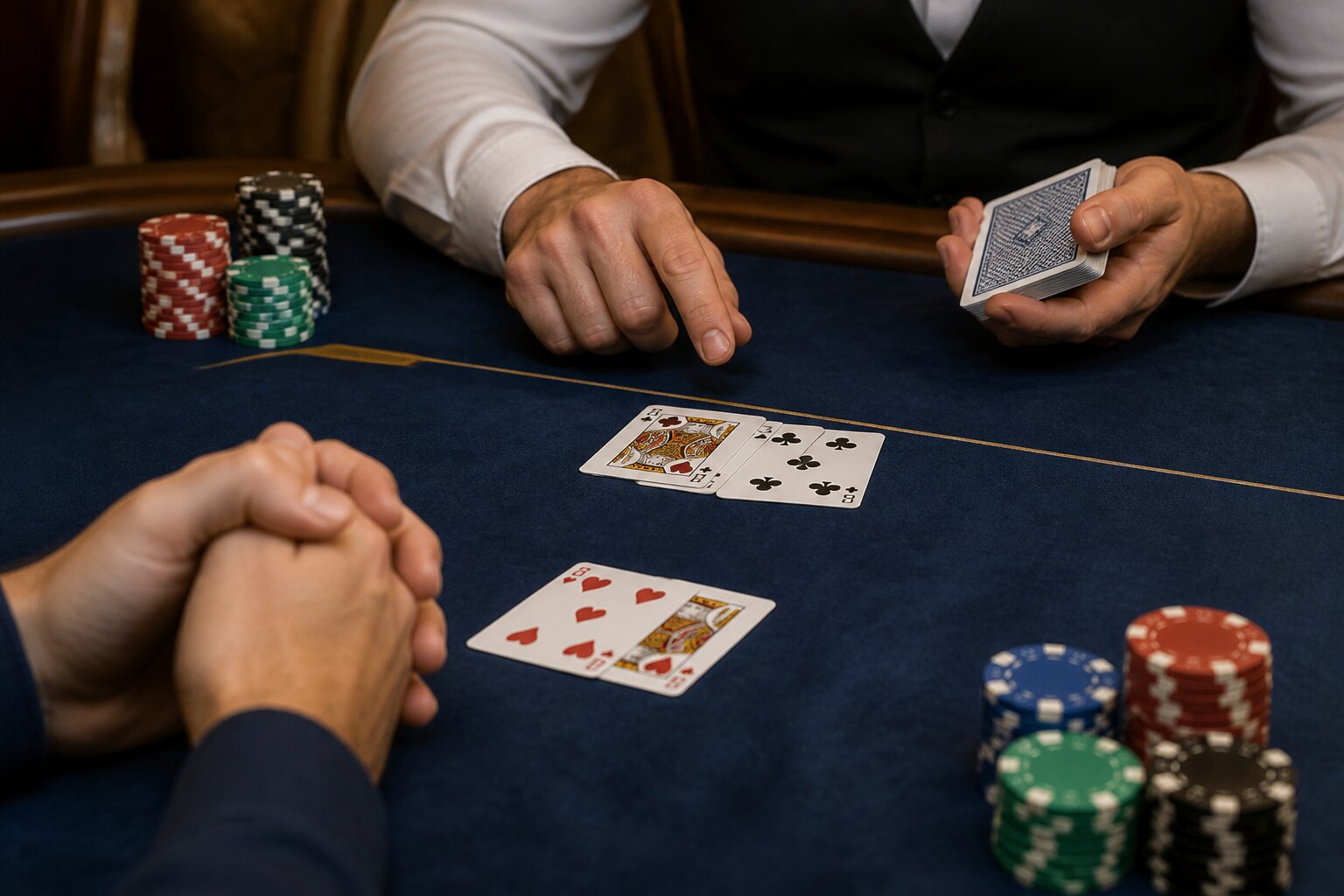
After bets are placed, the dealer deals two cards to each player and two to themselves, all face-down. The goal is to make a hand closer to 21 than the dealer’s without exceeding 21. If your first two cards are an Ace and a 10-point card, you have a Pontoon, the strongest two-card hand.
Players see only their own cards and decide how to proceed while the dealer’s cards remain hidden until every player has finished. This concealment makes the timing of choices — whether to take more cards or hold — more strategic.
Card Values and Scoring
Card values in Pontoon are simple: number cards are worth their face value; Jacks, Queens and Kings count as 10; Aces can count as 1 or 11 to produce the most favourable total for the hand without exceeding 21. The Ace’s flexibility can turn a risky position into a playable hand, for example an Ace and a 9 becomes 20, while a sequence like 5, 7 and 8 also makes 20.
Knowing these values helps with decisions about whether to draw further cards and informs the relative strength of hands such as two-card totals versus multi-card hands.
Drawing Cards: Twist and Stick
If a player does not have a Pontoon, they can choose to twist (take another card) or stick (take no more cards). Twisting continues until the player sticks or the hand exceeds 21 and is bust. Sticking preserves your total against the dealer’s eventual play.
A further option available in many Pontoon games is “buying” a card: placing an additional wager (up to the original stake) to receive one face-down card. Buying can be useful when a single extra card has a strong chance of improving the hand without relying on further draws. After buying, the player may still decide to twist or stick as appropriate.
The next subsection explains splitting pairs and how multiple hands are played independently.
Buying and Splitting Cards
When a player’s first two cards form a pair (for example, two 8s), they may split them into two separate hands by placing a second equal bet. Each new hand then receives an extra card and is played independently, creating two opportunities to beat the dealer. Splitting changes the risk profile because the player now manages two hands and two bets.
Buying differs from twisting because it involves an extra stake and a face-down card. A player might buy if their starting total gives a clear advantage to receiving exactly one more card rather than risking multiple twists. Once all players have resolved their actions, the dealer reveals their cards and settles each hand against the dealer’s total.
With the mechanics of play covered, the following section lays out the principal actions and what they mean for results.
What Are the Key Actions in Pontoon?
Every decision in Pontoon corresponds to a distinct action that affects the hand’s outcome. Familiarity with these actions makes it easier to judge risk and understand how different hand types are ranked when outcomes are decided. Learning what each action does also helps you anticipate the dealer’s responses and manage your play within your chosen limits.
Pontoon
A Pontoon is the two-card combination of an Ace and any 10-point card. It beats any other hand except a dealer Pontoon; when both player and dealer hold Pontoons, the usual result is a push and the player’s stake is returned. Because it is the top-ranking hand, it is paid at a higher rate than standard wins in most games, reflecting its relative rarity and strength.
Pontoons are distinct from other high-value hands because they require only two cards, which affects how you and the dealer might play earlier decisions. The presence of a Pontoon can change the incentive to twist or stick in surrounding hands, and many players adjust their approach when a Pontoon is possible.
Five Card Trick
The Five Card Trick is achieved by holding five cards without exceeding 21. It ranks behind a Pontoon but ahead of most other hands. For example, a sequence of small cards that totals 20 across five cards qualifies and will usually beat a regular two- or three-card 20 when the dealer does not have a Pontoon.
This rule rewards a conservative strategy that draws multiple low-value cards without busting. It can be particularly useful late in a shoe or when the dealer is showing weak cards, because the extra card count can override a higher total achieved with fewer cards.
Stick and Twist
“Stick” means to keep the current total and end the turn; “twist” means to request another card in an attempt to improve the hand. Both choices are central to strategy: sticking locks in a competitive total while twisting gives the chance to move closer to 21 at the cost of risking a bust. Buying and splitting are variations on these choices that alter how many cards are drawn and how bets are arranged.
Buying allows a player to exchange a card under certain rules to try to improve a two-card hand, while splitting lets a player turn a pair into two separate hands, each with its own stake. These options increase flexibility but also change the risk profile and the amount at stake, so they should be used with awareness of the rules at the table and the limits you have set for your play.
Understanding these actions prepares you for how the dealer will play their hand, which is explained next.
How Does the Dealer Operate in Pontoon?
The dealer manages the round by playing their own concealed hand after all players have completed their turns. The dealer must twist until they reach at least 17, and must stick on 17 or higher. This requirement standardises the dealer’s behaviour and prevents discretionary play.
If the dealer achieves a Pontoon or a Five Card Trick, those hands are resolved against each player’s results according to the table’s payout rules. Because the dealer reveals their cards only at the end, players must make decisions without knowing the dealer’s total, which influences the risk-versus-reward balance throughout the round.
Knowing how the dealer is obliged to act helps when deciding whether to be conservative or more aggressive with twists, buying or splitting in the moments before the dealer plays.
Winning and Payouts in Pontoon
Wins are determined by hand ranking and final totals: a Pontoon ranks highest, followed by a Five Card Trick, and then the highest total under 21. Standard two-card Pontoons and qualifying Five Card Tricks commonly pay at 2 to 1. Regular winning hands that beat the dealer but are not Pontoons or Five Card Tricks typically pay 1 to 1.
If both player and dealer have a Pontoon the result is usually a push and the player’s stake is returned. Specific paytables and rule nuances can vary between venues, so it is sensible to check the table’s payouts before you play. Treating play as entertainment and managing stakes carefully helps keep the experience enjoyable.
With payouts understood, the final section clarifies common terms you will encounter at the table.
Pontoon Terminology Explained
Below are the principal terms used in Pontoon along with concise examples to make them easy to remember.
- Pontoon: The top two-card hand of an Ace and any 10-point card. Example: Ace and King.
- Five Card Trick: Five cards totalling 21 or less. Example: 2, 3, 5, 4, 6 = 20.
- Twist: To request an additional card. Example: With 14, a twist brings a 5 to make 19.
- Stick: To keep the current hand and take no more cards. Example: Choosing to stick on 18.
- Buy: Paying an extra bet to receive one face-down card. Example: Adding an extra bet after being dealt 6 and 5.
- Split: Separating a pair into two hands with an equal additional bet. Example: Two 8s become two hands.
- Bust: A hand total over 21 that automatically loses. Example: 13 plus 9 equals 22 and is bust.
- Banker: The dealer who plays against each player’s hands. Example: The banker reveals their cards after players finish.
This glossary completes the guide and should leave you ready to follow a full round, recognise key hands and understand how outcomes are decided. Enjoy the game and keep your play controlled so rounds remain fun and straightforward.
Explore Casino Games at Barbados Bingo
Fancy finding a fresh way to relax and have some fun? At Barbados Bingo, we're here to welcome you to our friendly site and invite you to explore everything we have to offer.
**The information provided in this blog is intended for educational purposes and should not be construed as betting advice or a guarantee of success. Always gamble responsibly.