
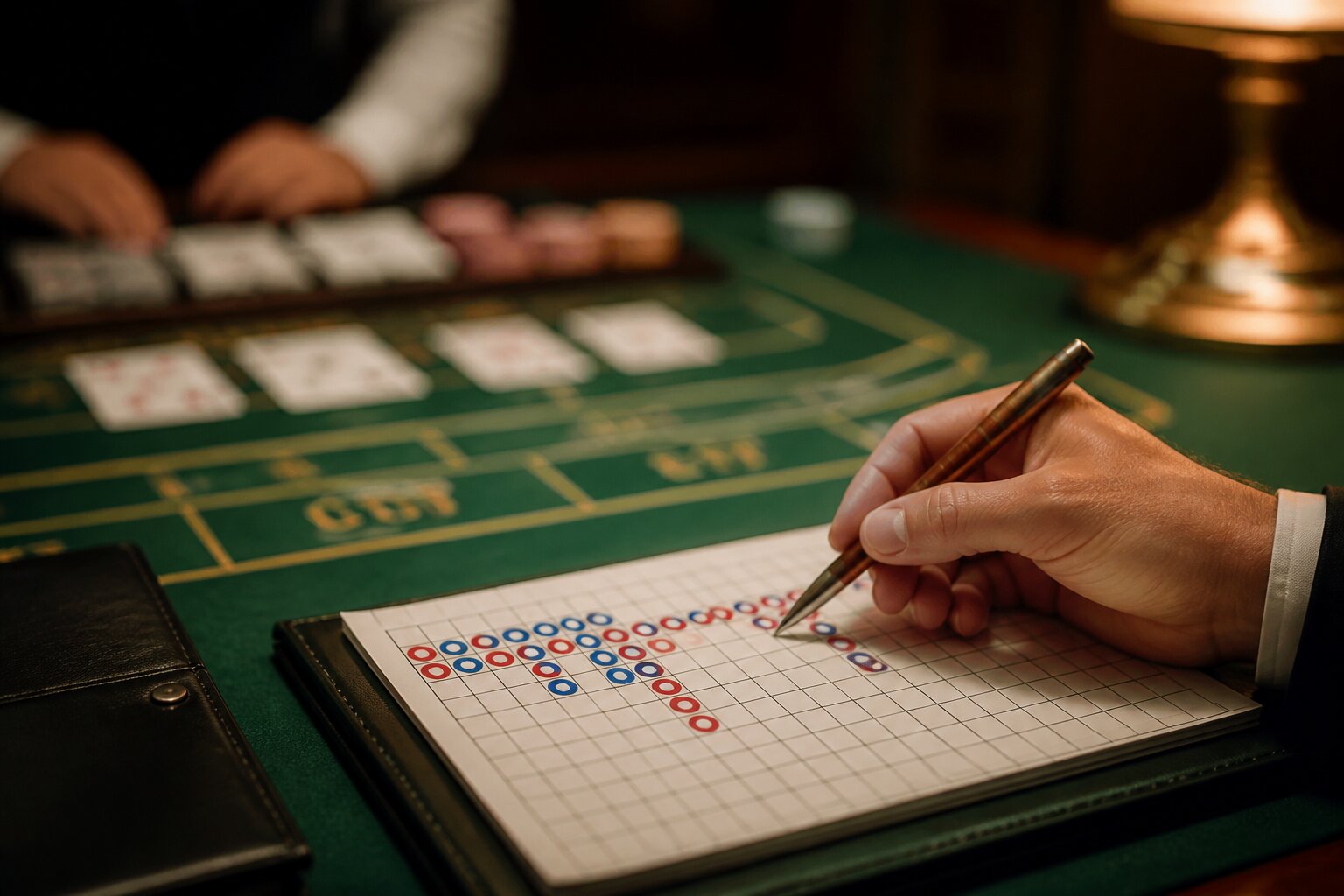
Baccarat has long been a favourite at casino tables, surrounded by whispers of secret-winning patterns and clever betting strategies. Many players believe there are recurring sequences will steer results, which fuels both excitement and confusion.
Are these secret strategies really the key to success, or are they just wishful thinking? This article separates fact from fiction, explaining how pattern tracking works in practice and what to expect when you sit down to play.
If you want to understand the mechanics behind those scorecards and why patterns feel convincing even when they’re not reliable, keep reading for a clear, practical view of baccarat play.
What Are Baccarat Patterns?
Baccarat patterns are simply ways that players record the sequence of hand outcomes—typically who won each round: player, banker or tie. Common visual formats include the “big road”, “bead plate” and similar grids or streak charts that show wins over time. Players glance at these to spot repeating shapes or runs that seem meaningful.
In practice, these grids are no more than a history of past results. They make it easier to spot clusters—several banker wins in a row, for example—or to imagine recurring cycles. That visual history can feel persuasive, but it is only a record, not a predictor. The way a pattern looks owes more to chance and the tendency for random sequences to produce short runs than to an underlying rule of the game.
If you want to see how people turn these records into betting choices, the next section explains common approaches and the thinking behind them.
How Do Players Use Patterns in Baccarat?
Many players use patterns as a decision aid. One common approach is to back the side that appears to be on a run—if the banker has won three times, they might bet on banker again. Another is to look for alternating sequences and stake on what appears to continue that rhythm. Casinos often make it simple by supplying scorecards or digital displays, so tracking becomes part of the experience.
These approaches are driven by human interpretation rather than mathematical advantage. For instance, two players could look at the same chart and reach opposite conclusions: one sees a streak to follow, the other sees one that’s about to break. The charts are useful for organising information and creating a narrative during play, but they do not change the probabilities embedded in how cards are dealt.
Players who prefer structure may find pattern tracking more enjoyable; those seeking a measurable edge should be aware that these methods are behavioural tools, not statistical ones. Read on to learn which myths around these methods are most common and why they persist.
Common Baccarat Pattern Myths Debunked
A cluster of misconceptions has grown around pattern-based play. These myths often sound plausible at first—after all, humans find order in randomness—but they don’t withstand closer examination.
One widespread misunderstanding is that patterns are predictable rules waiting to be discovered. That belief springs from seeing short-term sequences and assuming they will continue. Another is that some betting systems tied to patterns can overcome the house edge or guarantee wins. Both ideas overlook how baccarat outcomes are generated and the consistent mathematical advantage the house retains.
Below are two of the most persistent myths and why they don’t hold up under scrutiny.
The Myth of Predictable Sequences
Some players think baccarat produces long-term predictable cycles. In reality, apparent cycles are simply local structures created by randomness—short runs and alternations that appear by chance. While a row of banker wins might look like a “pattern”, there is no mechanism in the dealing process that causes results to follow a stable sequence that can be exploited.
False Promises of Guaranteed Wins
Sales pitches for systems that promise guaranteed wins are misleading. No pattern or staking plan can alter the underlying probabilities built into the game or remove the house edge. Claims of guaranteed success ignore basic probability and long-run variance; they prey on selective remembering of wins while forgetting inevitable losses.
With those misconceptions cleared up, it’s natural to ask whether any meaningful patterns exist at all. The following section looks at that question in practical and regulatory terms.
Are There Any Real Patterns in Baccarat?
When asking if “real” patterns exist, it’s helpful to separate two ideas: observable short-term sequences and exploitable, repeatable structures. Short-term sequences—streaks, clusters and runs—do appear from time to time simply because randomness produces local order. Exploitable structures, by contrast, would let a player systematically improve expected returns; those do not exist in properly run baccarat.
Licensed operators and independent auditors verify that card dealing and shuffling meet fairness standards, so outcomes are not engineered to create exploitable patterns. If a table shows a long run, it is a statistically expected occurrence over many rounds, not evidence of a rule you can rely on. Understanding this distinction explains why pattern watching may be entertaining but is not a dependable strategy.
This leads into why players are so keen to spot patterns in the first place — a topic the next section explores from a psychological angle.
The Psychological Attraction to Pattern Recognition
People are built to search for meaning and predictability. That instinct served us well in many areas of life, so it’s not surprising it extends to games of chance. Pattern tracking in baccarat taps into cognitive biases such as the clustering illusion—the tendency to perceive clusters in random data—and confirmation bias, where players notice hits more than misses.
These biases make charts feel informative and create emotional rewards when a bet follows a perceived trend. That reaction explains the appeal of pattern tracking even when it offers no statistical edge. Recognising these psychological drivers helps make sense of why pattern systems stay popular, and it also points toward sensible ways to approach them.
If you want to treat pattern tracking as part of the experience rather than a way to win, the next section explains how to do that while managing risk.
How to Approach Baccarat Patterns Responsibly
View pattern tracking as a personal preference or table ritual rather than a technique for improving outcomes. When used this way, scorecards can enhance focus and enjoyment without misleading expectations. A sensible approach includes setting clear money and time limits, treating each bet as independent, and avoiding chasing losses in the hope a pattern will reverse them.
Keep in mind that casino games are designed with a house edge; no amount of pattern-watching changes that built-in balance. If you choose to use charts, do so for the structure and atmosphere they provide, and keep stakes proportional to entertainment value rather than as an attempt to generate profit. Our safer gambling resources can help you identify practical limits and support if you ever need it.
Next, hear what experts in the field say about pattern-based play and how professionals view these practices.
Expert Opinions on Pattern-Based Play
Statisticians, gaming regulators and seasoned professionals largely agree that pattern-based betting does not change long-term expectation. Academic analyses demonstrate that while short-term variance can produce striking-looking runs, these do not translate into persistent, predictable outcomes. Regulators and auditors focus on ensuring that the dealing and shuffle processes meet strict standards so games remain fair and unpredictable.
Industry voices often recommend treating pattern systems as habit or entertainment rather than strategy. For players seeking a clearer sense of what to expect, experts emphasise discipline, understanding the mathematics of the game and setting personal limits—advice that preserves enjoyment without fostering false hopes.
That professional perspective brings us to the practical question many players face: is it worth trusting pattern strategies at all?
Should You Trust Baccarat Pattern Strategies?
Pattern strategies may be fun, but they are not a reliable path to consistent winnings. The mechanics of baccarat and the way outcomes are generated mean that no chart or streak-based system can overturn the game’s expected returns. Putting faith in patterns can lead to distorted expectations and risky behaviour.
If you enjoy tracking patterns, do so for the experience and keep wagers modest relative to your entertainment budget. Make decisions with an awareness of probability and with safeguards in place to prevent harm. By treating pattern-watching as an engaging part of play rather than a shortcut to success, it is possible to enjoy baccarat responsibly and with realistic expectations.
**The information provided in this blog is intended for educational purposes and should not be construed as betting advice or a guarantee of success. Always gamble responsibly.