Ever found yourself in a buzzing casino, cards in hand, wondering if this is the moment to double your bet? The thrill of blackjack ramps up when you spot a strong two-card total but the dealer’s upcard makes you hesitate. Double down at the right time and a single extra card can turn a modest stake into a much better return; pick the wrong moment and you risk more than you intended.
Knowing when to double down isn’t always obvious. The right decision depends on the combination of your cards and the dealer’s visible card, and it’s a strategic choice rather than a guess. Read on to learn what doubling down actually involves, the classic situations where the move is advisable, common mistakes to avoid, clear examples, and how the process differs between online and land-based play.
What Does It Mean To Double Down In Blackjack?
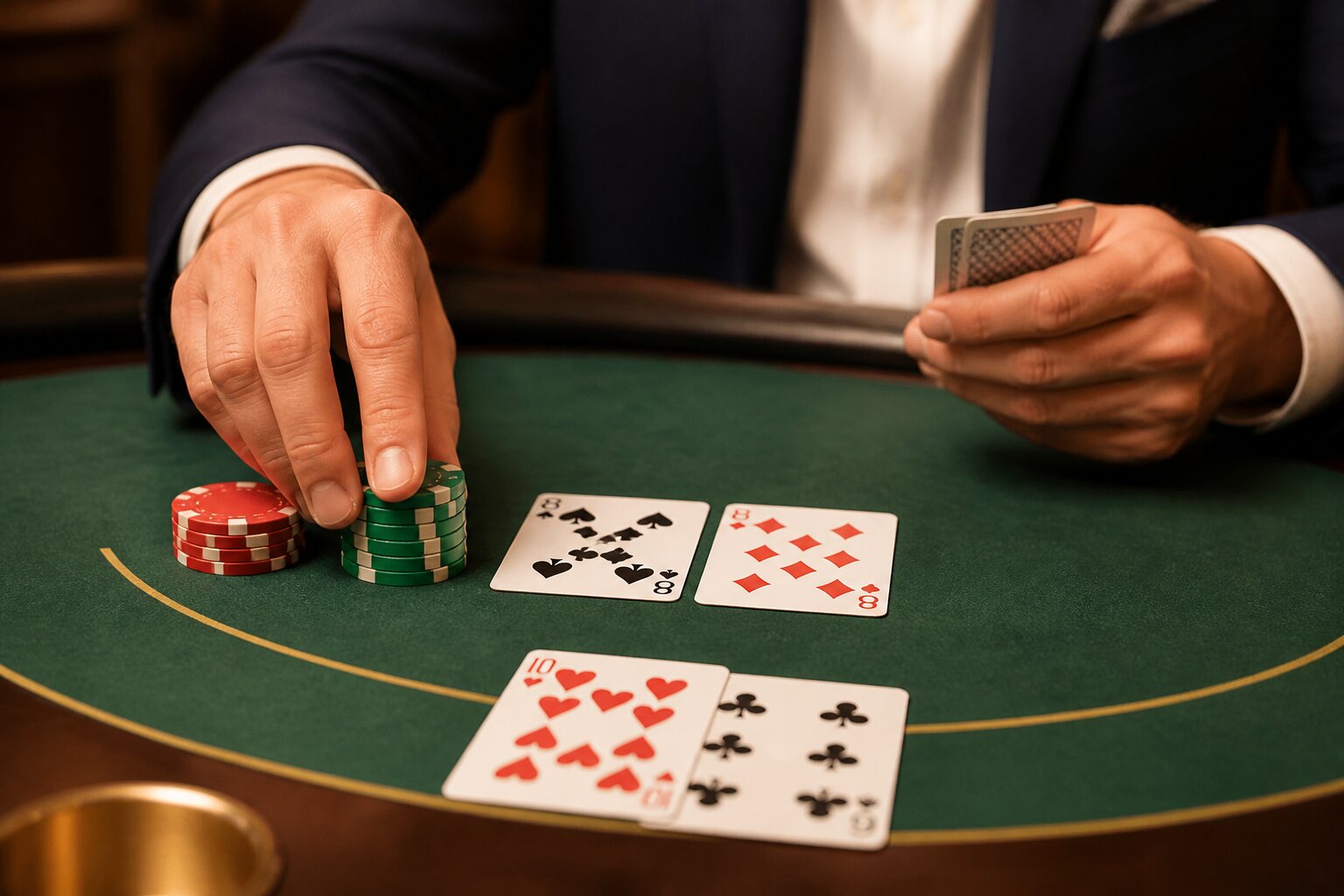
Doubling down in blackjack means doubling your original bet after seeing your first two cards, and then receiving exactly one more card. You can only do this at the start of your turn, before drawing any additional cards. Once the extra card is dealt, your play for that hand ends.
For example, if you place a £10 bet and your first two cards total 11 while the dealer shows a 5, doubling down puts another £10 beside your original stake so your total bet becomes £20. The dealer deals a single extra card, and that final total stands. This move is used in particular situations where the odds are more favourable for the player, because your single card is likely to make a strong final hand while the dealer is in a weak position.
The rule is consistent across most tables: double only after the initial two cards, and accept only one further card in return. Understanding this core rule will make the more detailed strategy that follows easier to apply.
When Should You Double Down In Blackjack?
Certain two-card totals present statistically stronger opportunities to double down, depending on the dealer’s upcard. These are the commonly accepted plays from basic strategy, chosen because they maximise your expected return over many hands.
- Double on a total of 11 when the dealer’s upcard is 2 through 10.
- Double on a total of 10 when the dealer’s upcard is 2 through 9.
- Double on a total of 9 when the dealer’s upcard is 3, 4, 5, or 6.
- Double on a soft 16, 17, or 18 (for example Ace-5, Ace-6, Ace-7) when the dealer shows 4, 5, or 6.
These plays work because the dealer is more likely to finish with a weak hand or bust, while your single extra card often produces a competitive total. The decisions listed above are precise, which makes them easier to apply at the table rather than relying on vague instincts. Next, we’ll look at the opposite side — common errors that increase risk and reduce your long-term return.
When Not To Double Down: Common Mistakes To Avoid
Knowing when not to double down is as important as knowing when to do it. Making this decision at the wrong time increases the chance of larger losses. Avoid doubling down in the following situations:
- When your total is below 9, such as 6 or 8.
- When the dealer’s upcard is a strong value, typically 7, 8, 9, 10, or Ace.
- On a hard hand of 12 or more, where a single card is unlikely to improve you without a high bust risk.
- On soft hands like Ace-2 when the dealer shows a high card.
- As a reaction to recent losses or on a hunch rather than a clear strategic rationale.
Keeping bets within limits you can afford and making measured choices helps manage risk. With a clear sense of when to avoid doubling down, you’ll be better prepared to recognise genuine opportunities when they arise.
Simple Examples Of Doubling Down
The following examples show how the rules and strategy play out in concrete hands, illustrating both favourable and risky situations. Each one highlights the reasoning behind whether doubling down made sense.
Example 1: Good Doubling Down Situation
You are dealt a 6 and a 5 for a total of 11. The dealer shows a 6.
You double your £10 bet to £20, then receive one more card — an 8 — taking you to 19. The dealer draws and eventually busts.
This is a textbook spot to double: 11 is strong because any 10-value card gives you 21, and the dealer’s 6 is a weak upcard that often leads to a busted hand. The single-card restriction is less of a problem here because the chance of a good outcome is high.
Example 2: Bad Doubling Down Situation
You have a 9 and a 5, totalling 14, and the dealer is showing a King.
Doubling to £20, you pick up a 6 and reach 20. The dealer then reveals a 10-value hole card and also finishes on 20, resulting in a push.
This demonstrates why doubling on a hard 14 against a strong upcard is risky: the dealer is likely to reach a high total, and your one extra card doesn’t reliably improve your position. The extra bet can easily be stranded.
Example 3: Risky Doubling Down On A Soft Hand
Your hand is Ace and 4 (soft 15) and the dealer shows a 10.
You double for an extra £10 and receive a 3, making 18. The dealer completes a 20.
A soft 15 can be flexible, but against a dealer 10 the odds aren’t in your favour. Doubling here exposes more funds in a matchup where the dealer is likely to finish strong, so it’s generally avoided.
These examples illustrate the logic behind basic strategy choices and why some totals are preferred for doubling while others are not. With those patterns in mind, the practicalities of where you play can affect how smoothly you can apply them.
Key Differences Between Doubling Down In Online vs. Land-Based Blackjack
The rule for doubling down — doubling your initial bet for a single extra card — is the same whether you play online or at a physical table, but the user experience differs and that can influence decision-making.
Online play uses clear on-screen controls, so the double option is a single button click and the pace is typically faster. Some online tables enforce different minimums and maximums than a bricks-and-mortar venue, and live-dealer streams combine human interaction with digital convenience. Pop-up confirmations sometimes prevent accidental doubles.
In land-based casinos you place extra chips beside your original bet and signal the dealer, which feels slower and more social. House-rule variations are more apparent in person, so it helps to ask the dealer about specific options before a session. Both formats present identical strategic choices, but the rhythm and chip-handling can change how comfortably you apply them. If you prefer one pace over the other, that choice will shape how consistently you put strategy into practice.
Frequently Asked Questions About Doubling Down
The move raises a few common queries among players. The answers below aim to be clear and practical for players at both online and land-based tables.
Can You Double Down After Splitting?
Whether doubling down after splitting is allowed depends on the table or game rules. Some venues permit doubling down on split hands, while others restrict doubling to the original two-card hand only. Check the specific table rules or the game interface before playing to be sure how the option applies after a split.
What Happens If The Dealer Gets Blackjack After You Double Down?
If the dealer has a natural blackjack, any player hands that are not also blackjack lose in full, including any doubled portion of the wager. In other words, doubling increases the amount at stake and that extra amount is lost if the dealer’s hand beats yours with a natural blackjack. Keep this increased exposure in mind when choosing to double.
Playing with clear strategy and sensible limits will help keep the experience focused on smart decisions rather than guesses. Overall, doubling down is a powerful tool when used in the right spots and avoided in the wrong ones; recognising those moments is the key to making the most of it.
Enjoy Casino Games at Barbados Bingo
We would love for you to become part of our friendly community of players and enjoy the entertainment on offer at Barbados Bingo. Experience the fun of our site in your own way and see what makes us a welcoming choice for casino fans.
Getting involved is easy: just create an account, make a deposit and you can start exploring our games. We look forward to seeing you join us and enjoying all that our casino has to offer.
**The information provided in this blog is intended for educational purposes and should not be construed as betting advice or a guarantee of success. Always gamble responsibly.