
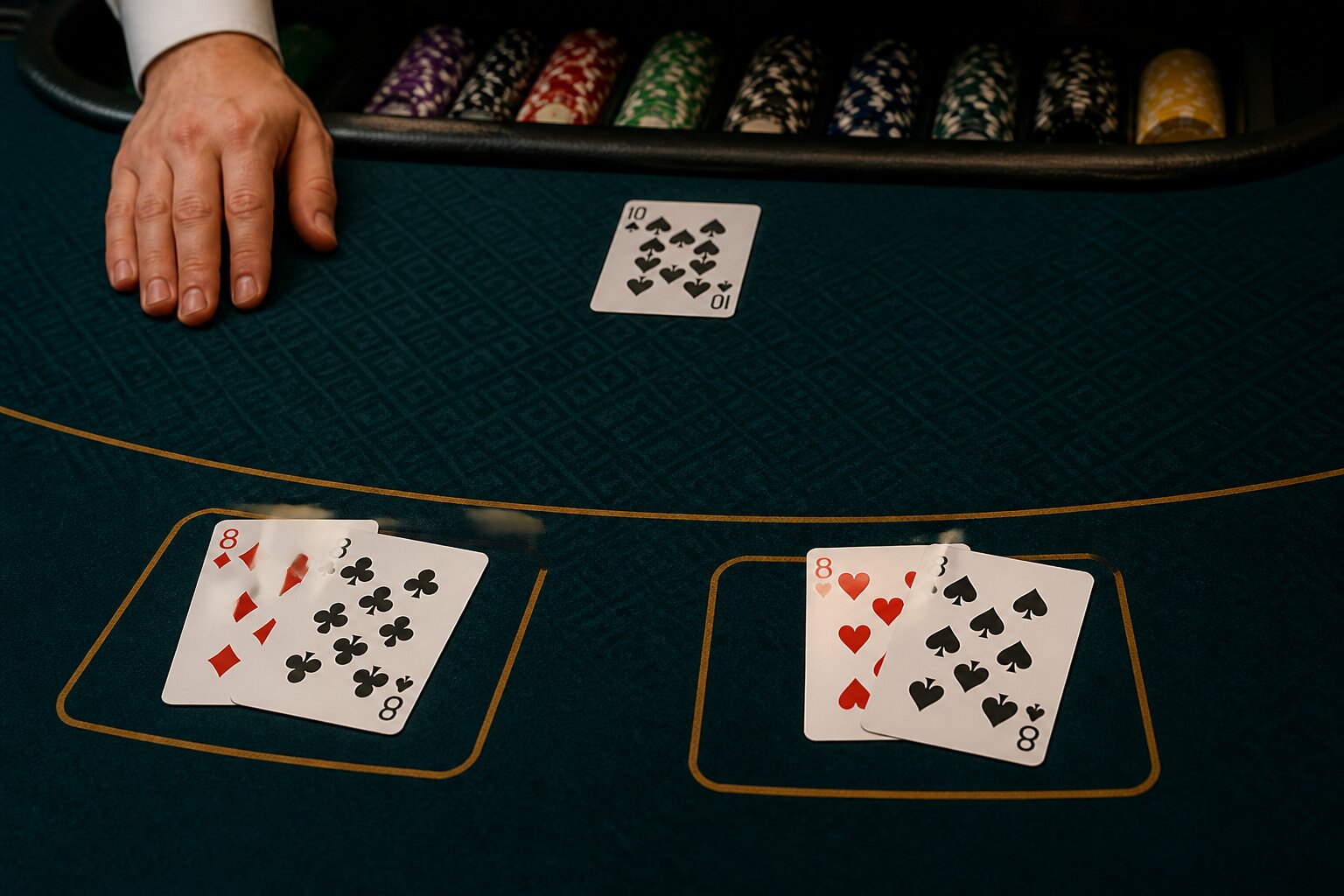
Nearly every blackjack player, whether new to the tables or a seasoned regular, has faced that nerve‑wracking moment: two 8s in your hand and the dealer showing a 10. Do you split and double the action, or stay put and hope for the best? It feels counter‑intuitive to increase your wager when the dealer appears so strong, yet the conventional advice to split comes from long‑term reasoning rather than short‑term optimism.
A pair of 8s makes a hard 16, one of the weakest totals in blackjack. Breaking the pair changes the structure of the hand entirely, transforming a single marginal position into two chances to reach a competitive total. The following sections explain why splitting is usually recommended, what the maths says, how it compares with standing or hitting, common worries about the play and how experienced players treat the decision. Read on to see how the choice works in practice and what it really achieves.
Why Do Players Split 8s in Blackjack?
Splitting 8s is widely endorsed because it reduces the expected loss compared with staying on 16 or taking a hit. A 16 is vulnerable: standing relies on the dealer busting or finishing lower, while hitting risks an immediate bust. Splitting replaces that single precarious total with two fresh hands, each beginning with an 8 and each able to draw toward stronger totals such as 18 or 19.
Practically, splitting shifts the risk profile. Instead of one hand with poor prospects, you have two hands that can independently improve. If you draw a low card to each split 8, you can continue to play both hands and potentially end with competitive totals; if you draw one poor card and one strong card, at least you have a better chance to recover some of your stake. This approach is not about flipping a losing situation into a guaranteed win but about limiting how much you give away on average when up against a strong dealer card. The next section lays out the numbers behind this reasoning.
The Maths Behind Splitting 8s Against a Dealer 10
The math explains why splitting is usually the least costly option over many plays. If you stand on 16 against a dealer 10, your historical win rate is low: you win roughly 23% of the time, push around 9% and lose the rest. Hitting improves or busts your hand unpredictably; the bust chance sits high and overall expected return drops compared with splitting.
When you split, you double the bet but also create two opportunities to reach stronger totals. Expected‑value calculations show that the average loss per unit wagered falls when splitting 8s versus standing or hitting. For example, standing might have an EV near −£0.53 per £1 wagered, hitting slightly worse at around −£0.54, while splitting moves that EV toward −£0.48 per £1. Those figures indicate you generally lose less over time by splitting, even though individual results vary.
This is damage limitation rather than a route to guaranteed profit: you can and will lose both hands sometimes. Still, the reduction in average loss is why basic strategy prescribes the split. With the maths in mind, it helps to compare the likely outcomes of the three main options you have against a dealer’s 10.
Comparing Splitting 8s with Other Player Options
When the dealer’s upcard is a 10, your choices with a pair of 8s are to split, stand or hit. Each carries different probabilities and trade‑offs that affect expected return.
What Happens If You Stand on 16 Against 10?
Standing relies on the dealer producing a worse final total or busting, but statistically that rarely occurs often enough to make standing attractive. More often the dealer makes a higher total such as 18–21 and your hand loses. Because the likelihood of a dealer final total above 16 is high, standing results in losses more frequently than wins.
Is Hitting a Better Choice Than Splitting?
Hitting converts your one weak total into a single attempt to improve, but many possible cards will cause a bust; any 6 or higher pushes a hard 16 over 21. While drawing a low card can produce a workable total, the overall bust rate when hitting is substantial and the average outcome tends to be worse than splitting. Even when a hit brings a better total, you still face the dealer’s strong position and so the expected value remains unfavourable.
Splitting does not guarantee success but it typically gives each hand a better chance to avoid the worst‑case outcome of a single hard 16. With that comparative picture clear, it’s useful to consider common concerns players raise about the strategy and how table rules can change the equation.
Common Concerns and Misconceptions
Players often expect a single decision to solve an awkward situation; splitting 8s is sometimes seen that way, which leads to misconceptions. The key point is that splitting reduces average loss rather than flipping the situation into a winning one. It won’t turn the dealer’s advantage into your advantage, but it usually results in a smaller long‑run deficit than standing or hitting.
Another common issue is table rules. Restrictive rules on splitting—such as allowing only one split, forbidding doubling after a split, or not permitting re‑splits—change the expected outcomes. For example, if re‑splitting is disallowed, getting another 8 after an initial split may leave you unable to convert that extra opportunity into a third hand; if doubling after a split is forbidden, you lose an option to capitalise on a strong draw. These limitations reduce the strategic edge that splitting normally provides, and they may prompt players to adjust their approach in that particular game.
Some players also misunderstand how much basic strategy helps: it shifts the distribution of outcomes so you win some hands you otherwise might have lost and lose some you might otherwise have won. That trade‑off is why the move is recommended in basic strategy but still depends on the precise house rules in play. With these concerns addressed, it’s helpful to see how experienced players incorporate the decision into their overall approach.
How Experienced Players View This Move
Experienced players treat splitting 8s against a dealer 10 as a routine, mathematically justified decision. They focus on long‑run effects rather than the outcome of any one hand: splitting reduces expected loss, which over many rounds preserves more of their bankroll than standing or hitting from 16. They also pay close attention to the specific table rules and the number of decks, since those factors influence the exact EV and can slightly alter the best choice in practice.
Seasoned players will adapt when rules limit splits or prohibit doubling after a split, and they will manage their stakes to match their tolerance for variance. The decision sits within a broader practice of playing consistently, tracking wins and losses, and staying within an agreed budget. That measured approach helps keep play controlled and deliberate.
Play Casino Games at Barbados Bingo
Fancy a bit of entertainment on your own terms? We welcome you to explore our online casino, where you can enjoy a wide choice of games at your leisure.
Getting started is easy: just create an account, make a deposit and you can dive in whenever you like. We look forward to having you with us.
**The information provided in this blog is intended for educational purposes and should not be construed as betting advice or a guarantee of success. Always gamble responsibly.