Ever found yourself at a casino table and wondered if blackjack and poker are the same thing? You’re not alone. With chips on the felt and cards being dealt, the two can look similar at a glance, but they reward very different skills and mindsets.
Both games use a standard pack of cards and sit at the heart of many casino floors across Britain, yet their aims, tempo and required thinking diverge quickly once play begins. Read on to see how rules, betting, interaction and payouts separate them—starting with the basics of how each game is played.
Understanding the Basic Rules of Blackjack and Poker
Blackjack is played with each participant competing against the dealer. The objective is to make a hand as close to 21 as possible without exceeding it. Players receive two cards and then decide whether to take more (‘hit’) or stop (‘stand’). If a hand totals over 21, it busts and loses immediately. The dealer follows a fixed set of house rules when playing their hand, commonly hitting until reaching 17 or higher.
Poker, by contrast, is a contest between players. Texas Hold’em, the most commonly seen form in the UK, deals each player two private cards and then places five community cards on the table across a sequence of rounds. Players form the best possible five-card hand from these seven cards or use betting to make other players fold. Where blackjack is a short, direct duel with the dealer, poker unfolds across several stages of decision-making that shape each hand’s outcome.
With those basics clear, the next section explains how each game’s objectives and flow differ in practice.
Key Differences in Objectives and Gameplay
While both games attract similar crowds, the way a round plays out and what players aim to achieve are quite distinct.
What Are the Main Goals in Each Game?
Blackjack’s goal is simple: have a hand value closer to 21 than the dealer’s, without going over. Players focus on their own totals and the dealer’s visible card to inform decisions within a single round.
Poker’s goal is either to hold the highest-ranking hand at showdown or to use betting so that every other player folds before showdown. Success in poker draws on psychological reading of opponents, timing of bets and longer-term chip management across multiple hands.
How Are Hands Played Differently?
In blackjack, hands are resolved one player at a time. Each participant’s choices—hit, stand, double or splitting pairs—apply only to their own hand against the dealer. The dealer’s actions follow set rules, so once cards are dealt the structure of play is relatively predictable.
Poker deals all active players into the same hand and features repeated betting rounds tied to shared community cards. Decisions such as folding, calling or raising affect the pot size and the information other players disclose about their hands. Because opponents’ choices influence the pot and future decisions, poker rewards adaptability and observation.
Next we’ll turn to how cards and hand values function in each game, since they underpin every decision players make.
Card Values, Hands, and Scoring Explained
Both games use the same deck, but the way cards count and the types of winning hands are entirely different.
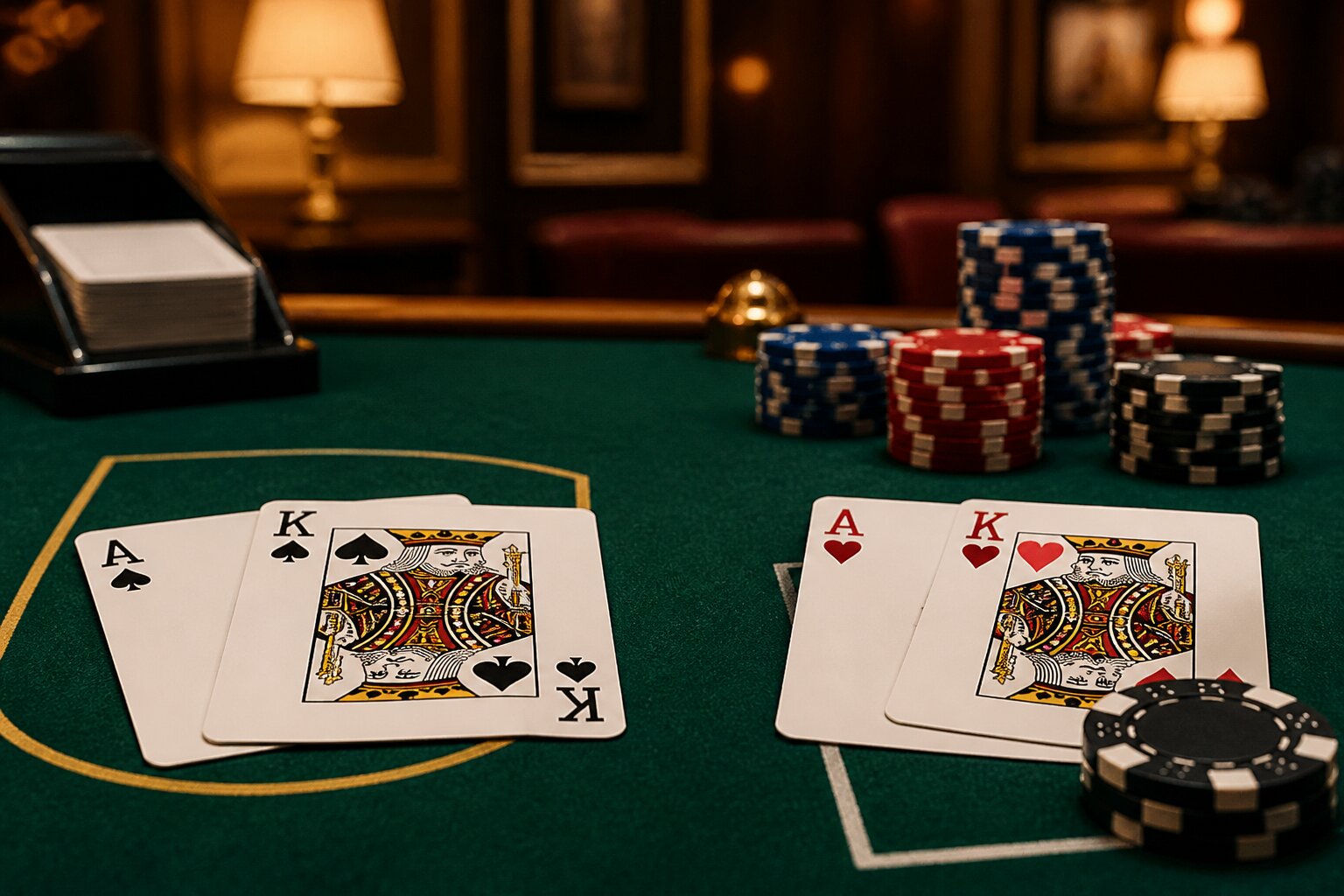
In blackjack, card values are numeric: number cards count face value; Jacks, Queens and Kings count 10; and Aces count as 1 or 11 depending on which benefits the hand. The best outcome is a “blackjack” — an Ace plus any 10-point card — which usually pays at a higher rate than a standard win. Typical hands are expressed as totals (for example, Ace + King = 21, or Queen + 6 + 5 = 21).
Poker ranks hands by combination rather than total. In Texas Hold’em the standard ranking from highest to lowest is:
- Royal Flush: Ace, King, Queen, Jack, 10 of the same suit
- Straight Flush: five sequential cards of the same suit
- Four of a Kind: four cards of the same rank
- Full House: three of a kind plus a pair
- Flush: five cards of the same suit
- Straight: five sequential cards of mixed suits
- Three of a Kind
- Two Pair
- One Pair
- High Card
Examples make this concrete: four nines is a very strong hand, a straight flush even stronger, while a single pair will often be insufficient at later betting stages. Understanding these differences in value clarifies why the games demand distinct approaches.
The next part looks at how bets are placed and how that shapes the pace of each game.
How Do Betting Rounds Differ Between Blackjack and Poker?
The structure of betting is one of the clearest contrasts between the two games.
In blackjack, wagers are placed before a hand begins and remain fixed for that round unless a player opts into an allowed variation such as doubling down or splitting pairs, which requires additional stake. Payouts are settled quickly at the end of the hand and play moves on to a fresh bet for the next deal. This makes blackjack rounds relatively brisk and predictable.
Poker uses multiple staged bets. In Texas Hold’em there are forced bets (blinds) to seed the pot, then further betting rounds after the flop, turn and river. Players can check, bet, call, raise or fold at each stage, and the pot can grow significantly before the final showdown. This layered betting creates greater variance in both risk and reward and requires attention to opponents’ tendencies across several actions.
How betting unfolds directly affects table atmosphere and the kind of strategy that works best; the next section explores how that social and competitive element differs between the games.
Social and Competitive Aspects Compared
The degree of direct competition and social interaction varies sharply between blackjack and poker.
Blackjack is essentially solitary in its contest: players act beside each other but are competing only with the dealer. This tends to limit table talk to brief, game-related comments and encourages quick decisions so play remains steady. Etiquette and clear signals are important to keep the round moving.
Poker tables are purposely social and interactive because players attempt to influence each other’s choices. Conversation, banter and deliberate table talk can be tools as well as social glue. Players observe tells, betting patterns and timing to gain an edge, and tournaments often foster a more sustained camaraderie or rivalry over time.
Understanding these contrasting environments helps players choose the setting that suits their temperament and skillset, and it also feeds into how wins are ultimately paid out, which we’ll cover next.
House Edge and Payouts: What Should Players Know?
The financial mechanics behind each game shape long-term expectations.
Blackjack includes a measurable house edge that depends on specific rules and the player’s strategy; commonly it falls between about 0.5% and 2% under favourable conditions. Typical payouts include 3:2 for a blackjack and 1:1 for standard wins, while side options such as insurance have their own fixed returns. Because the dealer follows set rules, skilled play can reduce the house advantage but cannot eliminate it entirely.
Poker’s cost structure is different: the casino’s share is taken as a rake from each pot or as tournament fees rather than a percentage built into hand odds. Individual payouts come from the accumulated pot or tournament prize pool and depend entirely on how well a player performs against opponents in that event. This means a player’s expected return is a function of skill relative to the field, not a fixed mathematical edge imposed by the game itself.
Whichever game a player chooses, it’s sensible to treat money spent at the table as the cost of entertainment. Manage a budget that fits personal circumstances and avoid staking more than can be comfortably afforded.
Play Casino Games Online at Barbados Bingo
We welcome you to explore the wide range of entertainment available on our site, with plenty of options to suit all kinds of tastes. There is always something new to discover, so you can enjoy having a choice whenever you fancy a bit of online fun.
It is easy to begin: simply create your account, make a deposit and choose what you would like to play. We look forward to having you with us at Barbados Bingo.
**The information provided in this blog is intended for educational purposes and should not be construed as betting advice or a guarantee of success. Always gamble responsibly.